


How to Avoid Fake Apple Watch Bands When Buying Online
Buy from Apple, an authorized reseller, or a brand’s official store, and you eliminate most counterfeit risk before it starts. If you’re shopping a marketplace listing or a used band instead, run three checks in the next 30 seconds: seller reputation and return policy, connector snap and fit, and material feel. A genuine band locks into the watch lug with zero side-to-side play, and the material never feels thin, squishy, or off-weight for its type.
If you already own a band you suspect is fake and it’s causing skin irritation, stop wearing it now. The remediation steps below cover refunds, reporting, and how to check your watch for connector damage.
- Buy direct first. Apple.com, an authorized reseller, or the brand’s own store removes almost all counterfeit exposure.
- Check the connector. Slide it onto a lug and wiggle gently. Genuine connectors don’t rattle.
- Feel the material. Apple’s fluoroelastomer sport bands feel denser and smoother than generic silicone; metal bands should feel substantial, not hollow.
TL;DR:
- Buying from Apple, authorized resellers, or the brand’s official store greatly reduces the risk of counterfeit bands.
- The connector should lock securely without wiggle, and the material feel must match the band type, such as dense silicone or substantial metal.
- Fake bands often show imperfections like different plastic shades, loose weaves, or lightweight materials that are easy to detect during physical checks.
- Marketplace purchases require specific verification, including photos of the connector fitting and seller account reviews, with buyer protection options available.
- Counterfeit bands can cause skin irritation, poor sensor contact, and physical damage to the watch, even if they do not void the warranty directly.
Table of Contents
- How Do You Spot a Fake Apple Watch Band Before Buying?
- What Are the Signs of Counterfeit Apple Watch Bands by Type?
- How Do You Safely Buy an Apple Watch Band Online?
- What Should You Do if You Receive a Fake Apple Watch Band?
- Does a Fake Band Affect Your Apple Watch Warranty?
- Why Connector and Material Checks Matter Most
- Get a Premium Metal Band Without the Marketplace Guesswork
- Key Takeaways
- Sources
How Do You Spot a Fake Apple Watch Band Before Buying?
Ten checks separate a confident buyer from someone who gets burned. Run through them in order when you’re evaluating a listing or holding a band in a store.
- Confirm the seller is authorized. Apple’s own site, Apple Stores, and verified big-box retailers carry zero counterfeit risk; third-party marketplace sellers vary widely.
- Read verified purchase reviews specifically, not just star ratings. Fake listings often have generic five-star reviews with no photos.
- Check for sealed, unopened packaging with printed model numbers matching the band size and color you ordered.
- Test the connector snap. It should click firmly into the lug with no wiggle in any direction.
- Run a lint test on sport bands. Genuine fluoroelastomer resists lint pickup; cheap silicone attracts it almost immediately.
- Look for size markings etched or printed on the band, consistent with Apple’s own labeling conventions.
- Check for the phrase “Assembled in China” printed cleanly on sport band connectors, a detail counterfeiters frequently get wrong, according to a crowdsourced comparison thread on MacRumors.
- Weigh metal bands in your hand. Genuine 316L stainless steel has real heft; lightweight metal bands are usually a lower-grade alloy.
- Compare the price to retail. A band priced 40% or more below the standard retail range is a signal, not a bargain.
- Verify compatibility claims match your Apple Watch generation, since real bands list exact series compatibility, not vague “fits most” language.
Pro Tip: Photograph the connector and packaging the moment you open the box. If you need to dispute the purchase later, timestamped photos are the strongest evidence you can hand a marketplace or card issuer.
What Are the Signs of Counterfeit Apple Watch Bands by Type?
Every band family has its own tell, and the fakes that fool people usually get one detail catastrophically wrong even when everything else looks convincing.
Sport bands
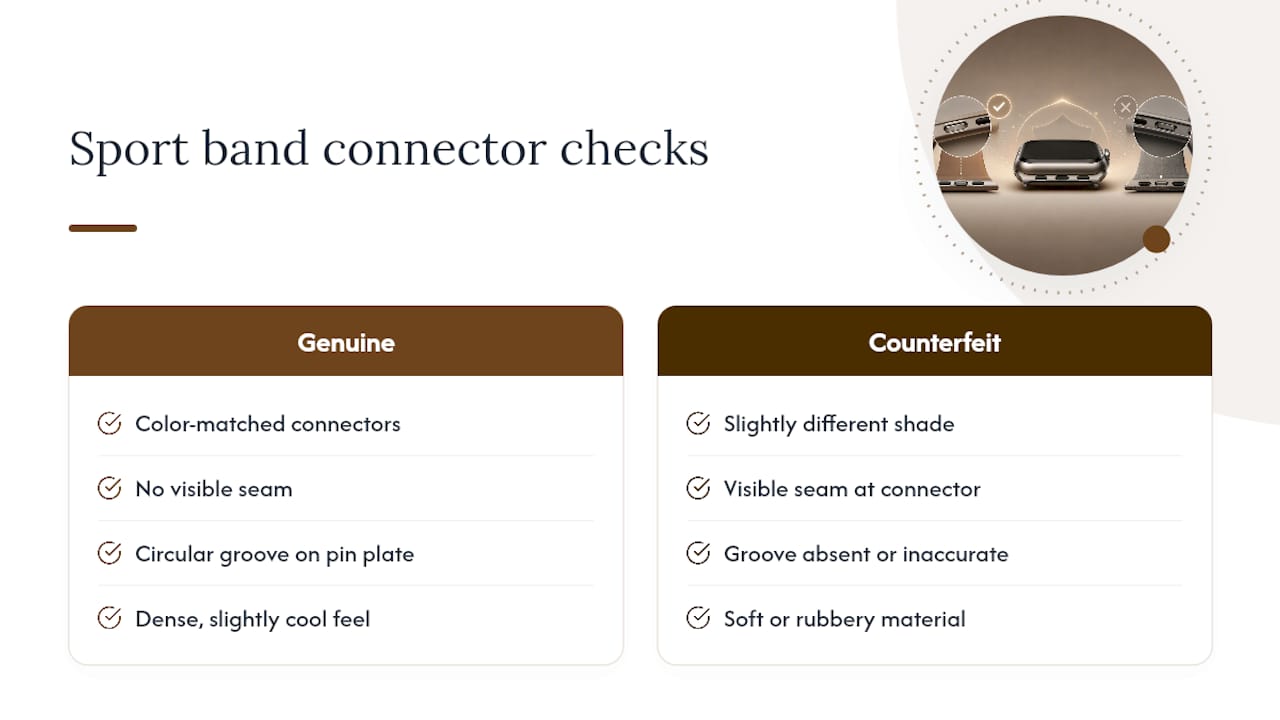
Genuine sport bands use color-matched plastic connectors that blend seamlessly with the band body. Counterfeits often use a slightly different shade of plastic or a visible seam where the connector meets the strap. Flip the band over and look for a circular groove stamped into the pin plate. A guide on detecting fake versus genuine OEM Apple bands notes that this groove is one of the hardest details for counterfeiters to replicate accurately. The material itself should feel dense and slightly cool to the touch, not soft or rubbery.
Sport loop and woven bands
Weave density is the giveaway here. Genuine sport loops have a tight, even weave with no loose threads at the edges. The hook-and-loop closure patch should sit centered on the band, not slightly off to one side, and the plastic lugs connecting to the watch case should have crisp, unrounded edges.
Solo Loop and Braided Solo Loop
These bands carry a numbered size etched directly on the lug, a detail counterfeiters frequently omit or print instead of engrave. Genuine Solo Loops also widen slightly near the lugs for structural support. A weave that stays uniform width from end to end, with no reinforcement near the connection points, is a common fake pattern.
Leather bands
Look for embossed markings near the buckle, not printed logos. The stitching should sit close to the edge with consistent spacing, and the embossing codes should be sharp, not smudged. For a broader sense of what separates real leather craftsmanship from imitation material, Vivien Lauren’s guide to spotting genuine leather covers grain patterns and finishing techniques that apply well beyond watch bands.
Metal bands
Weight is the fastest tell. Genuine 316L stainless steel bands feel substantially heavier than plated alternatives. The clasp should close with a clean, single click, never a loose double action or a mushy feel. Run the connector wiggle test here too: a genuine metal band’s connector locks into the lug with no lateral movement at all, while checklist-style buying guides for metal bands consistently flag any wiggle as a rejection signal.
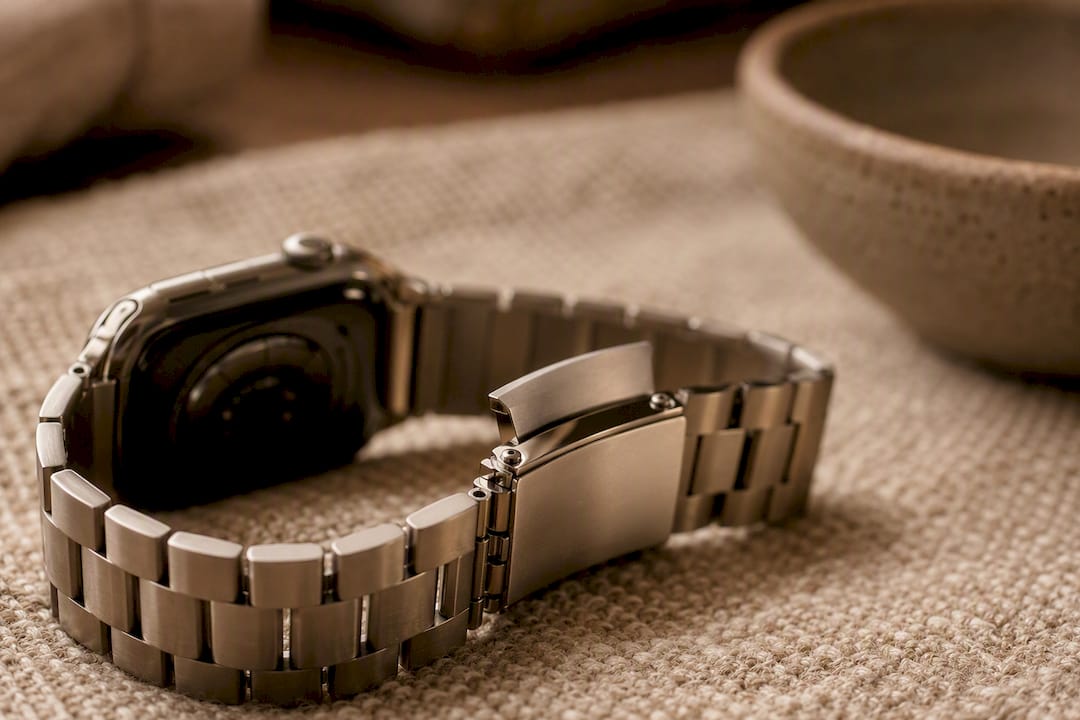
High-quality counterfeits now replicate packaging and printed markings convincingly enough that tactile checks, connector behavior, and clasp action have become the most reliable defenses left, according to the same OEM detection guide. Visual inspection alone isn’t enough anymore.
How Do You Safely Buy an Apple Watch Band Online?
A used listing or third-party marketplace purchase isn’t automatically risky, but it requires a specific sequence of checks before you commit.
- Request close-up photos or a short video of the connector snapping into place and any printed serial or model markings. A legitimate seller has no reason to refuse.
- Review the seller’s account history. A seller with months of consistent, varied listings and verified reviews carries far less risk than a brand-new account selling only Apple accessories at steep discounts.
- Confirm the platform’s buyer protection applies. Most major marketplaces offer money-back guarantees for items “not as described,” which covers counterfeit claims directly.
- Pay through the platform’s protected checkout, never through a direct bank transfer or a payment app that skips buyer protection entirely.
- Check the shipping origin. A listing claiming to ship from a US warehouse but fulfilled from overseas is a common red flag worth pausing on.
- Treat unusually low prices paired with “new sealed” claims as a mismatch. Genuine sealed retail stock rarely undercuts official pricing by more than a small margin.
Buying direct from the brand or an authorized reseller sidesteps this entire process, since it removes the marketplace variable that sophisticated counterfeiters depend on, per InStyle’s buying guidance.
What Should You Do if You Receive a Fake Apple Watch Band?
- Stop wearing it immediately if you notice redness, itching, or irritation, and photograph both the skin reaction and the packaging for your records.
- File a return through the platform’s buyer-protection process rather than negotiating directly with the seller, who has no incentive to cooperate.
- Dispute the charge with your card issuer if the marketplace return stalls or the seller becomes unresponsive.
- Report the listing through the marketplace’s fraud-reporting tool, and file a complaint with the FTC if the seller misrepresented the product as genuine Apple merchandise.
- Inspect your watch’s connector points for scratches or looseness, and contact Apple Support if you notice any damage tied to a poorly fitted band.
Does a Fake Band Affect Your Apple Watch Warranty?
A counterfeit band itself won’t automatically void your Apple Watch’s warranty, since Apple’s coverage applies to the watch hardware, not the strap. But the risk isn’t zero. A poorly fitted connector that scratches or bends the lug mechanism can cause physical damage that falls outside warranty coverage, because that damage stems from third-party accessory use rather than a manufacturing defect.
The bigger concern is functional, not contractual. Counterfeit bands can change how the watch sits against your skin, and experts note that shifted or loose contact often disrupts heart-rate sensor accuracy and Taptic Engine feedback. A band that’s slightly too stiff, too thick, or improperly shaped keeps the sensor array from maintaining consistent skin contact, which shows up as inconsistent heart-rate readings or missed notifications tapped through the Taptic Engine.
Long-term wear compounds the problem. Wired’s band testing found that lower-quality materials deform over weeks of daily wear, losing the shape and tension that keeps sensors properly positioned. A band that fit well on day one can fit poorly by week six, and that drift is where counterfeit materials tend to fail hardest. None of this shows up on a warranty claim form, but it shows up in your daily data and comfort.
Why Connector and Material Checks Matter Most
Packaging can be faked convincingly. A connector’s fit and a material’s density are much harder to fake, and they’re also what actually affects your watch’s performance day to day. A loose connector doesn’t just feel cheap; it lets the watch shift on your wrist, which throws off heart-rate sensing and Taptic feedback exactly the way background research on skin contact suggests it would. That’s why the wiggle test and the material feel test matter more than any logo or box.
Wizeband builds every band around that same principle: a snug connector, 316L stainless steel that holds its shape, and a clasp that closes with a clean, deliberate click. Reliable design isn’t cosmetic. It’s what keeps the watch reading your wrist correctly for years, not just weeks.
— John
Get a Premium Metal Band Without the Marketplace Guesswork
Skip the seller-vetting and connector-testing routine altogether by buying a band engineered to Wizeband’s own standard from the start. Every Wizeband strap is crafted from 316L stainless steel, fits Apple Watch Series 4 through 10, SE, and Ultra 2, and uses quick-adjust sizing with butterfly or jewelry clasps so you’re not guessing at fit the way you would with an unverified marketplace listing.
Buying direct from Wizeband’s own store removes the third-party layer where counterfeit risk actually lives. There’s no seller history to check, no photo requests to send, no wiggle test to run on a listing photo. You know the connector fit and the steel grade before it ships, because Wizeband designs and sells the band itself. If you want a straightforward starting point, the Wizeband Essentials Bundle pairs a couple of finishes so you can find the fit that suits your wrist without ordering multiple times.
Key Takeaways
Buying direct from Apple, an authorized reseller, or a brand’s official store eliminates most counterfeit risk, while connector fit and material feel remain the fastest checks for everything else.
| Point | Details |
|---|---|
| Buy from trusted sources first | Apple, authorized resellers, or a brand’s own store carry the lowest counterfeit risk of any channel. |
| Run the connector wiggle test | A genuine connector locks into the lug with no side-to-side play; a rattle signals a fake. |
| Match material to band type | Fluoroelastomer feels dense and lint-resistant; genuine metal bands feel notably heavier than cheap alternatives. |
| Know your remediation options | Marketplace buyer protection, card disputes, and FTC reports all apply if you receive a counterfeit. |
| Choose direct-from-brand for metal bands | Wizeband’s 316L stainless steel bands ship with verified fit and clasp quality, removing marketplace guesswork entirely. |
Sources
- How to tell between fake and genuine Apple Sport Bands? | MacRumors Forums
- 5 Best Apple Watch Bands: Nike, Nomad, and Hermés (2026) | WIRED
- Best Apple Watch Bands | InStyle
Recommended
Aus dem Blog
Alle anzeigen


Hinterlassen Sie einen Kommentar