


Ceramic Apple Watch Band Benefits: What You Need to Know
Yes — for style-conscious Apple Watch owners, ceramic replacement bands deliver a jewelry-like look with low-maintenance durability that metal and silicone simply cannot match. The material resists surface scratches, sits comfortably against sensitive skin, and holds its color for years without re-polishing. The one real trade-off: ceramic can chip on a hard corner drop, so it rewards careful daily wear.
Top three outcomes buyers get from ceramic bands:
- A polished, jewelry-grade finish that stays scratch-free through daily wear
- Hypoallergenic contact with no metal ions against the skin
- Color that never fades, even in sunlight, chlorinated water, or perspiration
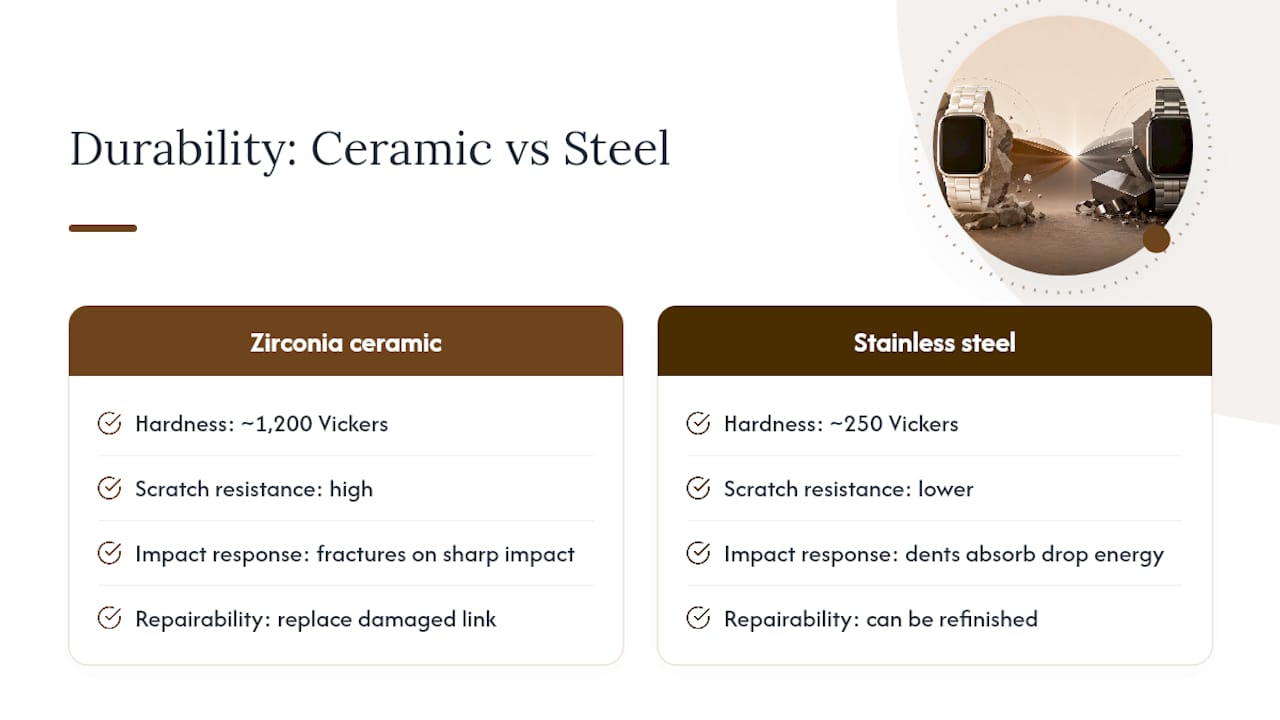
Hardness note: Zirconia ceramic reaches roughly 1,200 Vickers — nearly five times harder than stainless steel at approximately 250 Vickers. That gap explains why ceramic bands stay glossy while steel bands accumulate fine surface scratches over months of wear.
Key Takeaways
Ceramic Apple Watch bands deliver scratch resistance, hypoallergenic comfort, and a jewelry-like finish that holds up for years — with brittleness on sharp impact as the primary trade-off to manage.
| Point | Details |
|---|---|
| Scratch resistance is exceptional | Zirconia ceramic reaches roughly 1,200 Vickers — nearly five times harder than stainless steel. |
| Brittleness is the main risk | Hard corner drops can chip ceramic links; treat the band like fine jewelry to avoid fracture. |
| Color stays stable long-term | Pigments are integral to the sintered matrix, so UV, chlorine, and sweat cannot fade them. |
| Cleaning is simple | Mild soap and a soft microfiber cloth is all you need; avoid ultrasonic cleaners and solvents. |
| Wizeband ceramic options | The Granum and Perla Ceramic Straps offer jewelry-grade finishing at accessible price points. |
Table of Contents
- Why ceramic looks, feels, and performs differently than metal or silicone
- Pros and cons of ceramic bands compared with metal and silicone
- Ceramic watch durability: why it resists scratches yet can chip
- How ceramic bands wear day-to-day — comfort, weight, and skin contact
- Color and finish options, and how they hold up over time
- How to clean and care for a ceramic Apple Watch band
- Typical price range, lifespan expectations, and value proposition
- How to pick the right ceramic Apple Watch band
- When ceramic is the right choice for your Apple Watch
- Wizeband ceramic bands: where to start
- Sources
Why ceramic looks, feels, and performs differently than metal or silicone
Ceramic Apple Watch band benefits start at the material level. High-tech ceramic used in watch bands is typically zirconium dioxide (zirconia), formed by pressing fine powder under high pressure and firing it at extreme temperatures — a process called sintering. The result is a non-metallic, non-porous material that behaves more like a gemstone than a conventional metal alloy.
Blancpain’s workshop documentation details how this sintering process, combined with hand finishing, produces the smooth, light-catching surface that makes ceramic bands read as jewelry rather than hardware. Rado, which pioneered ceramic watch cases in 1986, describes the finished surface as delivering a “velvet-like” tactile quality that polished steel cannot replicate.
Color stability is another structural advantage. Pigments are integrated into the ceramic matrix during the high-temperature firing stage, not applied as a coating afterward. That means UV exposure, sweat, and pool chemicals cannot strip or fade the color — a failure mode common with PVD-coated metal bands.
Pros and cons of ceramic bands compared with metal and silicone
| Feature | Ceramic | Metal (steel) | Silicone |
|---|---|---|---|
| Appearance / jewelry-like look | High-gloss, jewelry-grade | Polished but scratches over time | Casual, matte |
| Scratch resistance / hardness | Very high (~1,200 Vickers) | Moderate (~250 Vickers) | Low |
| Weight | Light (roughly 25% lighter than steel) | Heavier | Very light |
| Hypoallergenic / skin comfort | Yes — no metal ions | Depends on alloy | Generally yes |
| Maintenance / long-term finish | Low — retains factory finish | Moderate — needs re-polishing | Low |
| Fragility / drop and chip risk | Higher — chips on sharp impact | Low — dents but rarely fractures | Very low |
| Price / typical replacement cost | Mid to high | Low to high | Low |
| Compatibility and clasp adjustability | Standard Apple Watch lug system | Standard lug system | Standard lug system |
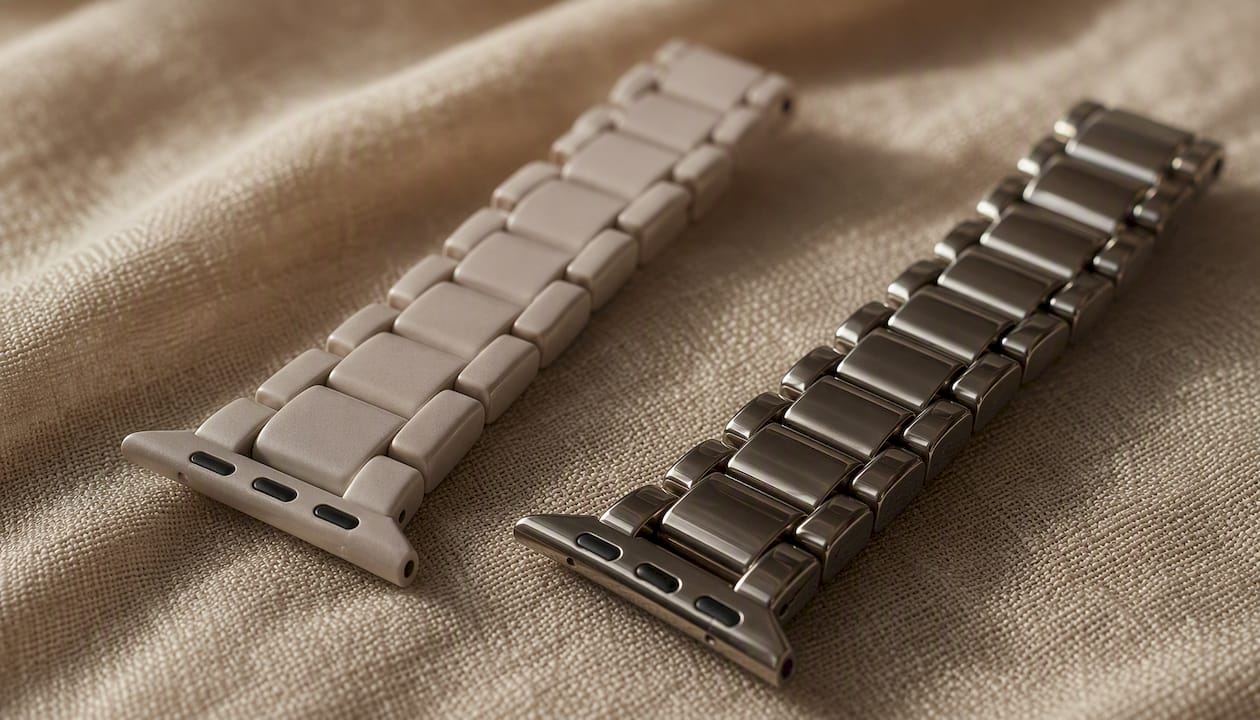
Single-sentence advantage: Ceramic holds a factory-fresh gloss for years without any re-polishing.
Single-sentence disadvantage: A hard corner drop can chip or crack a ceramic link in a way that steel simply dents through.
Pro Tip: Ceramic makes the most sense for formal settings and daily office wear — environments where the band faces friction and light contact but not gym equipment, hard countertops, or rough outdoor surfaces.
Ceramic watch durability: why it resists scratches yet can chip
The American Ceramic Society notes that brittleness is ceramic’s primary trade-off alongside its scratch resistance — and the two properties are directly linked. High hardness means the material resists deformation, but it also means it cannot absorb sudden impact energy by bending. Instead, it fractures.
Hardness vs. toughness: Zirconia ceramic sits at roughly 1,200 Vickers for hardness. Stainless steel sits near 250 Vickers. Steel’s lower hardness is what lets it absorb a drop by denting rather than cracking.
IWC Schaffhausen describes this plainly: ceramic is lighter and harder than steel, but owners should treat it like a fine piece of jewelry to avoid fracture on sharp impact. That framing is accurate for bands too. A band dragged across a rough concrete surface will emerge unmarked. The same band dropped edge-first onto tile may chip a link.
Repair usually means replacing the damaged link rather than refinishing it. Unlike steel, ceramic cannot be buffed back to shape. For most buyers, a chipped link means ordering a replacement link or a new band — which is why warranty and return policy matter more with ceramic than with metal.
How ceramic bands wear day-to-day — comfort, weight, and skin contact
The tactile experience of a well-finished ceramic band is one of its clearest advantages. Rado’s material documentation describes polished ceramic as thermally neutral — it does not carry the cold-on-first-touch sensation that metal bands produce in cool environments. The surface warms quickly to body temperature and stays comfortable through a full day.
Key comfort factors:
- Weight: Blancpain reports ceramic is roughly 25% lighter than steel in comparable constructions, which reduces wrist fatigue during long wear
- Skin friendliness: Ceramic contains no metal ions, making it a strong choice for anyone with nickel sensitivity or reactive skin
- Temperature behavior: Unlike metal, ceramic does not conduct heat aggressively, so it stays comfortable in both warm and cool conditions
Pro Tip: When sizing a ceramic band, check whether the clasp uses a butterfly or jewelry-style closure — these distribute pressure more evenly than a standard pin-and-tuck and reduce the chance of the band shifting and striking a hard surface.
Color and finish options, and how they hold up over time
Because ceramic pigments are locked into the sintered matrix rather than applied as a surface coating, the color is structurally part of the material. Pool chlorine, sunscreen, and direct sunlight — the typical fading vectors for coated metal bands — do not affect well-made ceramic links.
Common finish types and what they signal:
- High-gloss: The most jewelry-like option; reflects light sharply and pairs well with silver, gold, or starlight Apple Watch cases
- Satin: A softer sheen that reads as refined without being flashy; works across casual and formal outfits
- Matte: The most understated finish; pairs well with sport or aluminum Apple Watch cases for a modern, minimal look
For outfit pairing, high-gloss white or black ceramic reads closest to fine jewelry and works with dresses, blazers, and formal wear. Satin finishes are the most versatile across dress codes. If your Apple Watch case is Space Black or Midnight, a gloss black ceramic band creates a monochromatic look that holds up well over time without showing color shift.
How to clean and care for a ceramic Apple Watch band
Ceramic is low-maintenance, but a simple cleaning routine keeps the finish at its best. Longines recommends mild soap, a soft cloth, and routine cleaning to preserve the appearance of ceramic watch components for everyday wear.
Cleaning steps:
- Remove the band from your Apple Watch before cleaning
- Rinse the band under lukewarm water to loosen surface debris
- Apply a small amount of mild dish soap to a soft microfiber cloth
- Wipe each link gently — avoid scrubbing pads or stiff brushes
- Rinse thoroughly and pat dry with a clean cloth
- Allow to air dry fully before reattaching
Storage tips: Keep ceramic bands away from hard objects in a drawer or pouch. Contact with keys or metal clasps can cause chipping at the link edges over time.
Pro Tip: Avoid ultrasonic cleaners and solvent-based products. Ultrasonic vibration can stress ceramic links, and solvents may affect clasp coatings or gaskets. Mild soap and water is all you need to clean a ceramic Apple Watch band effectively.
Typical price range, lifespan expectations, and value proposition
Ceramic bands cost more than silicone and most entry-level metal options. The American Ceramic Society documents ceramic watch components spanning three-figure to four-figure price points, with the higher end driven by manufacturing complexity — sintering, injection molding, and hand finishing all add cost that a stamped metal or molded silicone band does not carry.
Value framing: A ceramic band that retains its factory finish for three or more years without re-polishing can cost less over time than a steel band that needs professional refinishing annually.
Lifespan drivers to consider:
- Wear pattern: Daily office and social wear extends lifespan; gym or outdoor use increases chip risk
- Accidental impacts: Corner drops are the primary failure mode — not surface wear
- Clasp quality: A well-engineered clasp reduces the chance of the band swinging loose and striking a hard surface
Wizeband positions its ceramic bands — including the Granum Ceramic Strap and Perla Ceramic Strap — as jewelry-grade alternatives at accessible price points, targeting buyers who want the finish longevity of high-end ceramic without the four-figure commitment.
How to pick the right ceramic Apple Watch band
The right ceramic band fits your watch size, matches your style priorities, and comes with a return policy that accounts for the material’s fragility risk.
Buying checklist:
- Compatibility: Confirm the band fits your Apple Watch series (Series 4–10, SE, or Ultra 2) and lug width (38/40/41mm or 42/44/45/49mm)
- Finish: Choose gloss for jewelry looks, satin for versatility, matte for minimal style
- Clasp type: Butterfly and jewelry clasps distribute pressure better than standard pin clasps
- Link adjustment: Check whether links are removable for sizing — not all ceramic bands offer this
- Warranty: Look for at least a 30-day return window given ceramic’s chip risk
- Return policy: A brand that accepts returns on ceramic bands signals confidence in its product quality
Pro Tip: In product photos, look for sharp light reflections on the link edges — well-finished ceramic shows clean, consistent highlights. Blurry or uneven edge reflections often indicate lower-grade finishing that will show wear faster.
When ceramic is the right choice for your Apple Watch
Ceramic Apple Watch bands suit a specific buyer well: someone who wears their watch daily in office or social settings, values a jewelry-like finish that stays pristine without effort, and is willing to treat the band with the same care as a piece of fine jewelry.
The Wizeband Granum Ceramic Strap and Perla Ceramic Strap represent the brand’s ceramic lineup — designed for buyers who want that finish longevity without moving into luxury watch pricing.
Ideal buyer profiles:
- Style-conscious daily wearers who want a band that reads as jewelry, not sportswear
- People with sensitive skin or nickel allergies who need a fully hypoallergenic option
- Owners who want a low-maintenance finish that holds up without re-polishing or special treatment
- Buyers upgrading from silicone who want something that pairs with formal and business-casual outfits
Ceramic is not the right call for high-impact lifestyles — gym sessions, construction work, or frequent outdoor activity. For those use cases, a silicone band or a stainless steel option handles impact without fracture risk.
Wizeband ceramic bands: where to start
If you want a ceramic look with jewelry-grade finishing, Wizeband’s ceramic collection offers two clear starting points. The Granum Ceramic Strap suits buyers who want a structured link style with a high-gloss finish — it pairs well with silver and gold Apple Watch cases and reads as formal jewelry. The Perla Ceramic Strap offers a softer, more delicate look suited to everyday wear and business-casual outfits.
For buyers who want to pair a ceramic band with a complementary metal option, the WizeBand Essentials Bundle combines styles so you can switch between looks without buying separately. All Wizeband bands are compatible with Apple Watch Series 4–10, SE, and Ultra 2, and the brand offers a return policy that lets you assess fit and finish before committing. Browse the full ceramic lineup to find the finish and clasp style that fits your daily wear.
Sources
- The Marriage of TECHNOLOGY and Tradition | Lettres du Brassus
- Ceramics help keep time but usually at a hefty price - The American Ceramic Society
- Art of Ceramic | Rado
- The Ceramic Watch Case - lighter & harder than steel | IWC Schaffhausen
- Ceramic Watches: Benefits of Style and Durability | LONGINES US
Recommended
Aus dem Blog
Alle anzeigen


Hinterlassen Sie einen Kommentar