


Multi-Chain Watch Bands: Style, Construction, and How They Work
What is a multi-chain watch band?
A multi-chain watch band is a decorative wrist strap featuring several interlocking metal chains that run parallel across the wrist. Unlike a standard silicone or leather strap, this style draws directly from jewelry design. The result is a band that reads as a bracelet first and a watch accessory second.
The core purpose is aesthetic. Multi-chain bands are built to transform a smartwatch, particularly the Apple Watch, into something that looks at home alongside fine jewelry. The chains are typically crafted from stainless steel or jewelry-grade alloys, and most designs include universal adapters that fit Apple Watch sizes from 38/40/41mm through 42/44/45/46/49mm.
Key characteristics of multi-chain watch bands:
- Multiple parallel metal chains running side by side across the wrist
- Jewelry-inspired clasps, including butterfly and secure jewelry closures
- Stainless steel or alloy construction for durability and finish
- Universal adapter systems for broad Apple Watch compatibility
- Suitable for both casual daily wear and formal occasions
Table of Contents
- How watch bands and bracelets differ from each other
- Common types of watch bracelets, including multi-chain styles
- What are multi-chain watch bands made from?
- How to style multi-chain bands for the best look
- The history and evolution of multi-chain watch bands
- Advantages and disadvantages compared to single-chain or traditional bands
- Watch models and brands that feature multi-chain watch bands
- Wizeband makes it easy to wear your Apple Watch like jewelry
- Key takeaways
How watch bands and bracelets differ from each other
Watch bands and watch bracelets are not the same thing, though the terms get used interchangeably. The distinction matters when you are choosing a multi-chain style.
A traditional watch band is a single-strap accessory. Its job is functional: keep the watch on your wrist. Rubber, leather, and nylon bands all fall into this category. A watch bracelet, by contrast, is metal and linked, designed with aesthetics as a primary driver alongside function. Multi-chain bands sit firmly in bracelet territory, leaning toward decoration without sacrificing wearability.
Key distinctions at a glance:
- Watch bands: Single strap, functional focus, materials like rubber, leather, or nylon
- Watch bracelets: Metal links, decorative focus, structured and jewelry-adjacent
- Multi-chain bands: Multiple linked chains, hybrid of bracelet style and band function
- Comfort: Multi-chain bands flex with the wrist like a bracelet, unlike rigid cuff styles
- Style impact: A multi-chain band changes the visual weight of the watch significantly, pulling it toward jewelry
Common types of watch bracelets, including multi-chain styles
Classic bracelet types include mesh, link, cuff, and multi-chain styles, each with a distinct look and feel. Understanding where multi-chain fits among these helps clarify what makes it a specific choice rather than a generic one.
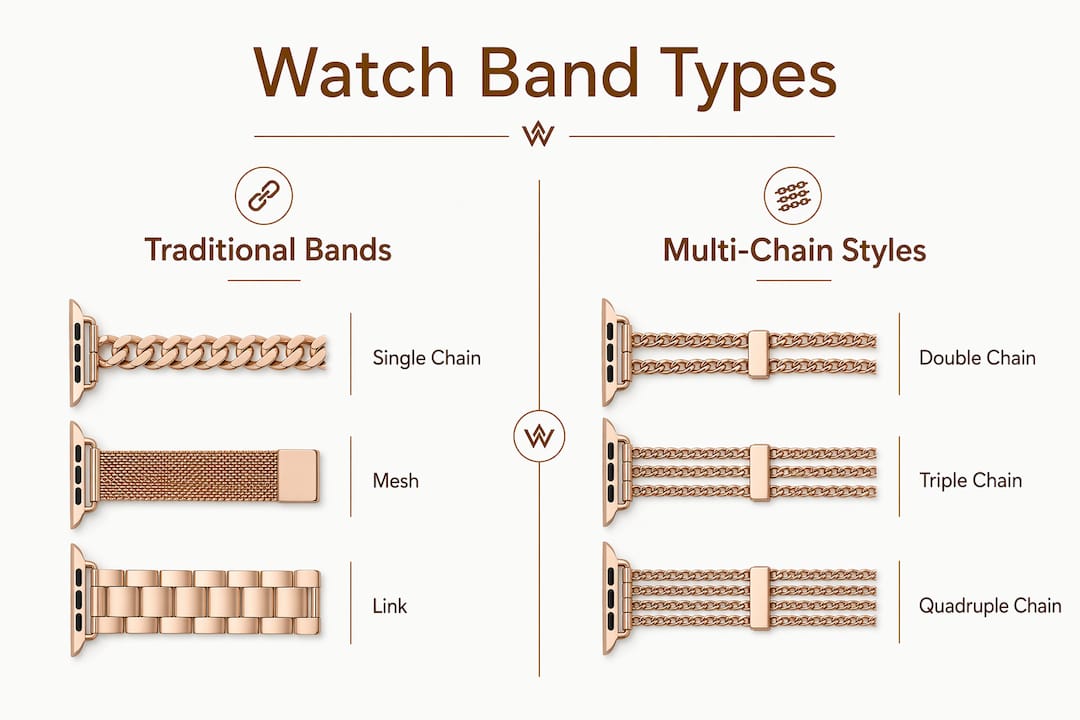
| Bracelet Type | Construction | Visual Style |
|---|---|---|
| Mesh | Fine interwoven metal wire | Sleek, minimal, flat profile |
| Link | Individual metal links joined in a row | Classic, structured, traditional |
| Cuff | Solid or semi-solid metal band | Bold, architectural, statement |
| Multi-chain | Multiple parallel chains side by side | Layered, jewelry-inspired, dimensional |
Multi-chain designs vary within their own category. Some feature two chains of equal weight. Others stack three or four chains of different link sizes, creating a cascading, layered effect. The number of chains and the variation in link style directly affect the visual outcome.

Jewelry design is the clearest influence on multi-chain construction. The same principles that govern stacked bracelet styling apply here: varying link sizes creates depth, while uniform chains read as flat.
Pro Tip: When browsing multi-chain options, count the number of chains and check whether the link sizes differ between them. A band with two or three chain weights will look more dimensional on the wrist than one where every chain is identical.
What are multi-chain watch bands made from?
Construction quality separates a multi-chain band that lasts from one that fades or breaks within months. The materials and engineering details are worth understanding before buying.
Common metals and construction features:
- 316L stainless steel: The most durable option, resistant to tarnish, corrosion, and daily wear
- Jewelry-grade alloys: Lighter than steel, often used for rose gold and two-tone finishes
- Butterfly clasps: Fold flat against the wrist, secure, and visually clean
- Jewelry-style clasps: Snap closures modeled on fine bracelet hardware
- Removable links: Allow resizing at home without tools on many designs
- Universal adapters: Connect the band to Apple Watch lugs across all case sizes
Most multi-chain bands use butterfly or jewelry clasps for secure fastening combined with a high-fashion look. Adjustability varies by design. Some bands use a clasp-based micro-adjustment system. Others require removing individual links. A small number of designs need a proprietary tool for link removal, while others use a simpler snap-off system that requires no tools at all. Checking the adjustment method before purchasing is practical, especially if your wrist size falls between standard sizes.
How to style multi-chain bands for the best look
Styling a multi-chain band well comes down to one principle: let it lead. Because the band itself carries significant visual weight, the rest of the wrist should support it rather than compete with it.
Mixing different chain link sizes and styles within a multi-chain band creates a dimensional, cascading aesthetic that enhances the watch’s fashion appeal. A band where every chain is the same width reads as flat. One where the chains vary in weight and link style reads as intentional and styled.
Practical styling guidance:
- Keep other wrist accessories minimal when wearing a multi-chain band
- On the same wrist, avoid stacking additional bracelets unless they are very thin and delicate
- On the opposite wrist, a single thin bracelet or cuff can create balance without crowding
- Stick to one metal tone for a clean look, or use a two-tone band as a bridge between gold and silver pieces elsewhere in the outfit
- For formal settings, a single-tone silver or gold multi-chain band reads as jewelry without effort
- For casual wear, rose gold or mixed-finish chains work well with everyday outfits
Pro Tip: Treat the multi-chain band as the main wrist statement. If you are wearing a bold band, skip the stacked rings and extra bracelets. One strong piece reads better than three competing ones.
The history and evolution of multi-chain watch bands
Chain-link jewelry has been part of human adornment for thousands of years. Ancient Egyptian and Roman craftsmen produced interlocking metal chain bracelets using techniques that, in principle, are not far from modern link construction. The shift from purely decorative chains to functional watch straps came much later.
Through the mid-20th century, metal link bracelets were standard on dress watches. The Oyster bracelet, introduced by Rolex in 1947, and the Jubilee bracelet from the same era established the link bracelet as a mark of quality watchmaking. These were single-chain designs, engineered for precision fit and durability.
Multi-chain styles, featuring two or more parallel chains rather than a single linked row, emerged more prominently from fashion jewelry rather than traditional watchmaking. As smartwatches arrived and the Apple Watch launched in 2015, a gap opened between the tech device and the jewelry aesthetic many wearers wanted. Multi-chain bands filled that gap directly, borrowing from stacked bracelet and layered chain jewelry trends that were already well established in fashion.
By 2024 and into 2026, multi-chain bands for the Apple Watch have become a recognized category, with designs ranging from two-chain minimalist styles to elaborate four-chain quadruple designs with mixed link weights and finishes.
Advantages and disadvantages compared to single-chain or traditional bands
Multi-chain bands offer real benefits, but they are not the right choice for every situation. A clear comparison helps set expectations.
Advantages:
- Visual impact far exceeds a single-chain or rubber band
- Jewelry-adjacent aesthetic works for formal and semi-formal occasions without a separate bracelet
- Flexible construction moves naturally with the wrist, unlike rigid cuffs
- Available in finishes like rose gold, silver, and two-tone to match existing jewelry
- Compatible with Apple Watch across multiple series without additional hardware
Disadvantages:
- More links mean more surface area to clean and maintain
- Heavier than silicone or nylon bands, which some wearers notice during extended wear
- Resizing can require more effort than a simple buckle adjustment
- Not ideal for high-activity use, swimming, or workouts where a secure, minimal band performs better
- Higher price point than basic rubber or fabric bands
Compared to a single-chain link band, a multi-chain design adds visual complexity but also adds weight and maintenance. For everyday office or social wear, the trade-off favors the multi-chain style. For active days, a lighter band is the practical choice.
Watch models and brands that feature multi-chain watch bands
The Apple Watch is the dominant platform for multi-chain band designs. Its standardized lug system and two-size structure (small case and large case) make it straightforward for band makers to produce designs that fit the entire lineup from Series 4 through Series 10, SE, and Ultra 2.
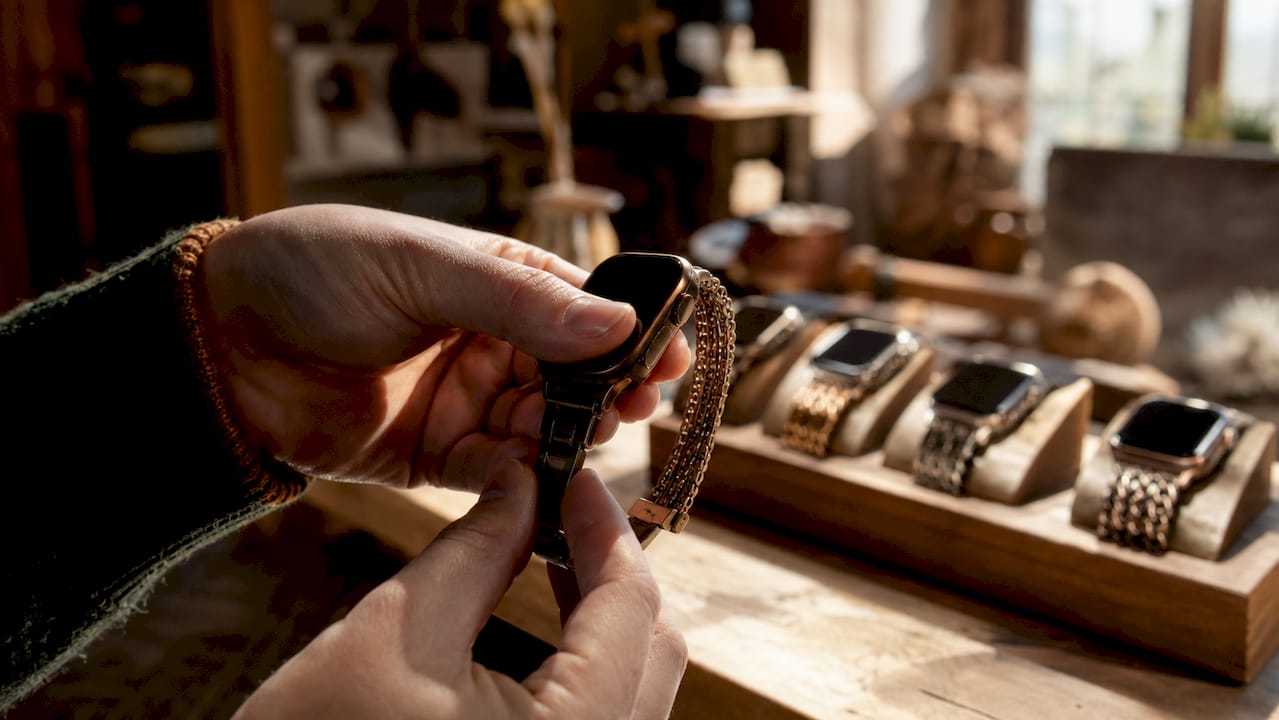
Anne Klein produces a multi-chain alloy metal link band specifically designed for the Apple Watch, available at major US retailers including Macy’s. The band features a rose gold-tone or two-tone alloy construction with a secure jewelry clasp closure and is splash resistant.
Wizeband’s lineup covers the same Apple Watch range with multiple multi-chain families, including quadruple-chain styles in Silver Gold, Rose Gold, Starlight, and Gold finishes. The Nete Stainless Band and the Daphne Metal Band are examples of designs that bring layered chain construction to everyday Apple Watch wear.
Beyond the Apple Watch ecosystem, traditional Swiss and Japanese watch brands have historically offered metal link bracelets as standard options, though these are typically single-chain designs rather than multi-chain. The multi-chain style remains most closely associated with fashion-forward smartwatch accessories rather than mechanical watchmaking.
Wizeband makes it easy to wear your Apple Watch like jewelry
If you came to this article wanting to understand multi-chain bands and now want to actually wear one, Wizeband is a direct path from interest to purchase. The brand has been designing metal Apple Watch bands since 2016, with a specific focus on bands that look like jewelry and hold up like everyday accessories.
Every Wizeband band is crafted from 316L stainless steel with butterfly or jewelry clasps and quick-adjust systems. The lineup covers Apple Watch Series 4 through 10, SE, and Ultra 2, offered in two size groups so there is no guesswork at checkout. For multi-chain styles specifically, the Aura Metal Band and the Tokyo Metal Strap combine layered chain construction with durable stainless steel in finishes that work from the office to a dinner out. Browse the full collection at Wizeband.com and find the band that fits both your wrist and your style.
Key takeaways
Multi-chain watch bands are the clearest way to wear an Apple Watch as jewelry, combining layered metal chain construction with universal compatibility and jewelry-grade clasps.
| Point | Details |
|---|---|
| Core definition | A multi-chain band features multiple parallel interlocking metal chains, designed for a jewelry-inspired look on smartwatches. |
| Materials | Most quality bands use 316L stainless steel or jewelry-grade alloys with butterfly or jewelry clasps for secure wear. |
| Compatibility | Most designs fit Apple Watch cases from 38/40/41mm through 42/44/45/46/49mm via universal adapters. |
| Styling rule | Let the band lead: minimize other wrist accessories and vary chain link sizes for a dimensional, polished look. |
| Wizeband | Wizeband offers multi-chain Apple Watch bands in stainless steel with quick-adjust systems, covering Series 4 through Ultra 2. |
Recommended
Aus dem Blog
Alle anzeigen


Hinterlassen Sie einen Kommentar