


Layering Watch Bands with Bracelets: A Style Guide
Treat your Apple Watch band as the anchor, place a soft buffer piece directly beside it, then add a few contrasting bracelets above. Match at least one bracelet metal to your watch case finish for a cohesive look. Keep the sensor area and crown clear. Wear the stack on your non-dominant hand to reduce friction and wear.
Quick rules:
- Watch and its band = the anchor
- Soft or smooth material goes next to the watch face (the Buffer Rule)
- 1–3 accent pieces above the buffer, toward the elbow (for most metal bands); slim bands like Nova can handle up to four delicate bracelets.
- One bracelet metal repeats the watch case finish
- some clearance from the watch body where possible
This approach protects the watch finish, preserves heart rate and charging function, and creates a wrist stack that reads as intentional jewelry rather than a random pile of accessories.
Table of Contents
- What should you decide before you start stacking?
- How do you build a layered wrist stack step by step?
- Which materials mix well and which ones cause problems?
- Which Wizeband bands and bracelet styles work best together?
- How do you fit, adjust, and protect your watch and bracelets?
- What does a layered wrist look like for different occasions?
- How do you choose a jewelry-like Apple Watch band worth buying?
- Key Takeaways
- A practical note on styling jewelry-like watch bands
- Wizeband bands built for a layered wrist
- Sources and further reading
What should you decide before you start stacking?
- Wrist side. Wear the stack on your non-dominant hand to cut friction and reduce the chance of knocking the watch.
- Occasion. Everyday, office, or evening each calls for a different number of pieces and weight level.
- Watch case finish. Silver, Gold, Rose Gold, or Starlight determines your bridge metal when mixing tones.
- WizeBand family. Agatha, Gaia, Nete, Goran, Nova, Electra, or Swift Leather each has a distinct profile that pairs differently with bracelets.
- Bracelet edges. Avoid sharp-edged cuffs or loose-stone pieces placed directly against the watch case.
- Spacing. Keep a moderate gap between each piece and the watch body.
Pro Tip: Pick one bracelet that repeats your watch case metal exactly. That single bridge piece makes a mixed-metal stack look deliberate rather than accidental.
How do you build a layered wrist stack step by step?
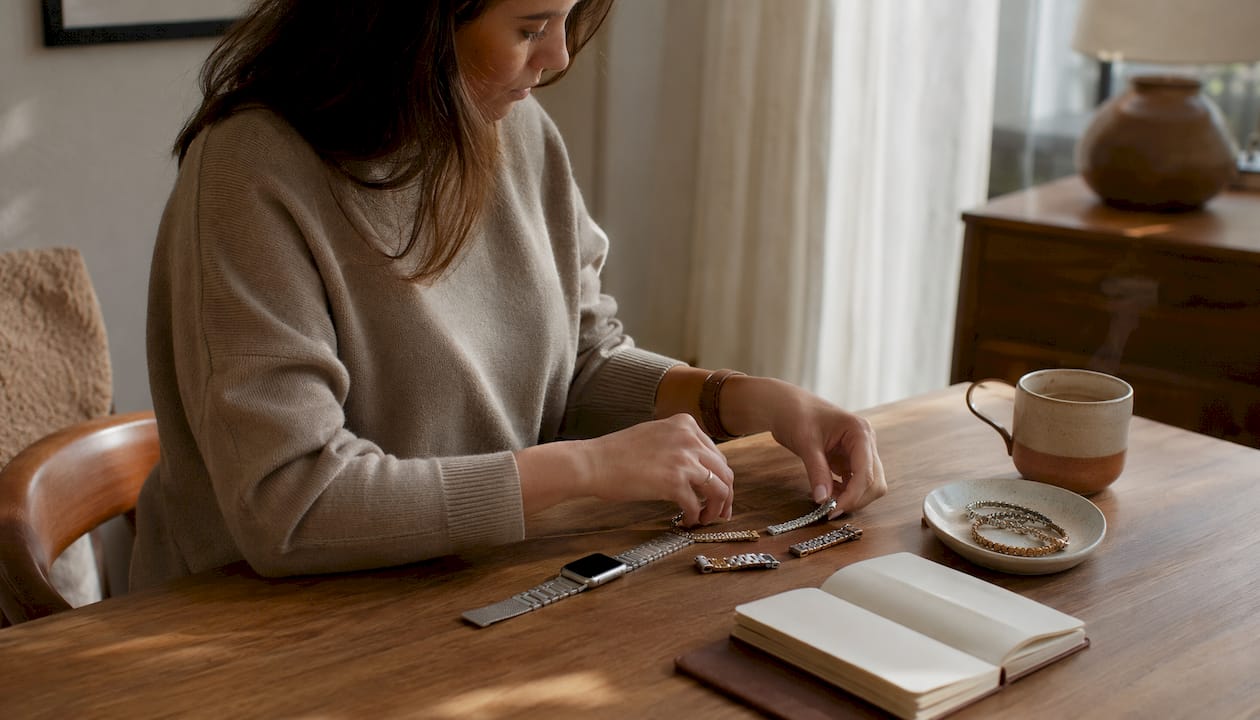
- Attach your band. Fit your jewelry-like Wizeband strap snugly. It is the visual anchor for everything that follows.
- Add the buffer. Place a soft or smooth piece directly beside the watch face. Thin leather, a silk cord, a slim silicone band, or a fine rounded chain all work. The Buffer Rule protects the watch case and creates a visual pause between the watch and the rest of the stack.
- Build textural rhythm. Alternate rigid pieces (bangles, cuffs) with fluid ones (chains, beads). This prevents the stack from reading as one solid block of metal.
- Check proportionality. A large watch case pairs with fewer, thinner bracelets. A smaller case can carry up to four or five delicate pieces without looking overloaded.
- Set placement order. Bracelets sit above the watch toward the elbow. Avoid stacking tight bangles between the watch and your hand, where they tangle with the band and crown.
- Run a function check. Confirm the crown, side buttons, and charging area are clear. Maintain the 4–12 mm clearance from the watch body.
Example combos:
- Minimalist: Nete Stainless Band + one slim paperclip chain as the buffer
- Soft-luxe: Agatha Metal Strap + thin leather cord buffer + one pearl station bracelet
- Textural: Gaia Metal Strap + fine mesh buffer + one bangle + one beaded piece
Pro Tip: Test the full stack before leaving the house. Lift your arm, flex your wrist, and check that nothing slides over the crown or catches on the charging port.
Which materials mix well and which ones cause problems?
| Material combo | Works well? | Notes |
|---|---|---|
| 316L steel band + polished metal bracelet | Yes | Match or intentionally contrast metal tones; use a bridge piece if mixing |
| Ceramic band + polished metal or pearls | Yes | Avoid abrasive metal bangles directly against ceramic coating |
| Metal band + leather or silicone buffer | Yes | Best scratch protection; good sensor clearance |
| Two fine chain bracelets side by side | Caution | Insert a solid-form piece between them to prevent tangling |
| Magnetized clasps near watch back | No | Can interfere with sensors; keep magnetic hardware away from the case |
| Porous bead bracelets + metal band | Caution | Remove before swimming; porous materials absorb moisture and degrade |
| Heavy ferrous metal bangles against case | No | Abrasion risk and potential magnetic interference |
When mixing metals, always include one bridge piece that repeats or blends both tones. Ceramic bands pair beautifully with polished metals and pearls, but check the coating for wear over time. Leather and silicone are the safest buffer layers for both scratch protection and sensor clearance.
Pro Tip: Metal-on-metal contact is the primary cause of surface wear on smartwatches. A well-fitted leather or silicone buffer between the watch case and the first metal bracelet eliminates most of that risk.
Which Wizeband bands and bracelet styles work best together?
All Wizeband bands are built from 316L stainless steel with butterfly and jewelry clasps, quick-adjust link systems, and multiple finishes. Every band fits Apple Watch Series 4–10, SE, and Ultra 2 across two size groups.
- Agatha Metal Strap: A classic metal link band that anchors formal and office stacks. Pair with a thin tennis bracelet as the buffer and one slim bangle farther up the wrist. Works in Silver Gold and Rose Gold.
- Gaia Metal Strap: A feminine link style that suits layered wrist jewelry ideas with pearls or fine chains. Use a silk cord or fine mesh as the buffer; add one fluid chain above.
- Nete Stainless Band: Available in seven finishes, making it the easiest bridge piece when mixing metals. Pairs with paperclip chains for everyday wear.
- Goran Stainless Band: A bold link profile. Keep the bracelet count low (1–2 pieces) so the band stays the focal point.
- Nova Stainless Band: Slim and polished. Handles up to four or five delicate pieces without visual overload.
- Electra Stainless Strap: A statement-level band. One refined cuff or bangle above it is enough for evening wear.
- Luxury Set Bundle: Multiple band styles in one purchase, useful for building different stacks across occasions without buying separately.
- Swift Leather Strap: The natural buffer choice. Wear it as the base band when the occasion calls for a softer look, then layer metal bracelets above.
Pro Tip: The Nete’s seven-finish range means you can almost always find an exact match for your watch case color, which is the fastest way to make a mixed-metal stack look intentional.
How do you fit, adjust, and protect your watch and bracelets?
Sizing and adjustment:
- Use Wizeband’s quick-adjust link system to set a snug fit before adding bracelets. A loose band slides toward the bracelets and increases contact wear.
- After adding bracelets, re-check the watch position. Tighten slightly if the stack causes the watch to migrate toward the hand.
- Keep bracelets above the watch toward the elbow so the band acts as a natural backstop.
Sensor and crown protection:
- Maintain 4–12 mm clearance between each bracelet and the watch body.
- Leave the underside clear for heart rate sensors and the charging area. Use slide-off or removable bracelets for workouts and overnight charging.
- Avoid strong magnets directly over the watch back.
Care schedule:
| Material | Cleaning frequency | Key caution |
|---|---|---|
| 316L stainless steel | Weekly | Wipe with soft cloth; avoid abrasive cleaners |
| Silicone | Weekly | Rinse with water; dry fully before re-wearing |
| Leather | Monthly | Condition with leather balm; keep dry |
| Beads / porous materials | After each wear | Remove before swimming; inspect elastic cords |
For detailed guidance on how metal links wear over time, the ChronoCare maintenance guide covers link wear patterns and when to resize.
Pro Tip: Store bands and bracelets separately when not in use. A 12-slot watch strap organizer keeps metal pieces from scratching each other overnight.
What does a layered wrist look like for different occasions?
- Daytime/active. Swift Leather Strap as the base + one slim chain above it + one light bead piece for color. Keep total weight low. The leather buffer protects the watch during movement.
- Office/minimal. Nete or Agatha band + one slim tennis or paperclip chain directly beside the watch as the buffer + one refined bangle near the elbow. Two pieces total above the band. Clean, proportional, and functional all day.
- Evening/formal. Polished Electra or Gaia band + a pearl or diamond station piece as the buffer + one statement cuff farther up the wrist. Three pieces maximum. The cuff provides volume without crowding the watch.
Quick style notes:
- Volume control: one statement piece per stack, everything else stays slim
- Asymmetrical balance beats perfect symmetry for a modern look
- For smartwatch function at any occasion, the crown and sensor area stay clear regardless of how many pieces you add
How do you choose a jewelry-like Apple Watch band worth buying?
Buying checklist:
- Metal grade: 316L stainless steel is the standard for durability and hypoallergenic wear
- Clasp type: butterfly or jewelry clasp for secure, low-profile closure
- Quick-adjust feature: lets you resize at home without tools
- Compatibility: confirm fit for your specific Apple Watch Series (4–10, SE, Ultra 2)
- Finish options: Silver, Gold, Rose Gold, Starlight — match to your existing jewelry
Questions to ask sellers:
- Is the finish plated or solid? Plated finishes wear through faster with daily stacking.
- Are the materials hypoallergenic? 316L steel and ceramic are generally safe; verify with the seller for any coated or mixed-material bands.
- Is the band adjustable for stacking? A quick-adjust system lets you loosen the fit slightly when adding bracelets.
- What is the edge profile? Rounded edges reduce contact wear on adjacent bracelets.
Check product pages for link types and clasp details before buying. Sizing guides and compatibility notes should list every Apple Watch series the band fits.
Key Takeaways
The most effective approach to layering watch bands with bracelets is to treat the watch as the anchor, place a soft buffer beside it, and build outward with one to four contrasting pieces (for slim bands) or one to three (for standard bands) that share at least one metal tone with the watch case.
| Point | Details |
|---|---|
| Watch as anchor | Build every stack around the watch and its band; all bracelets support it, not compete with it. |
| Buffer Rule | Place a soft or smooth material directly beside the watch face to protect the case and sensors. |
| 4–12 mm clearance | Keep bracelets within this spacing range from the watch body to prevent scratching and interference. |
| Match one metal | Repeat the watch case metal in at least one bracelet to unify mixed-metal stacks. |
| Wizeband as the base | Wizeband’s 316L stainless bands with butterfly clasps and quick-adjust systems are built to anchor a layered wrist stack across Apple Watch Series 4–10, SE, and Ultra 2. |
A practical note on styling jewelry-like watch bands
The conventional advice on bracelet stacking tends to focus on analog watches, where the only real concern is scratching the case. With an Apple Watch, there is a second layer of consideration: the sensors, the crown, and the charging area all need to stay accessible. Most styling guides skip that entirely.
The approach that actually works is simpler than most people expect. Start with a band that already reads as jewelry, so the watch itself carries the visual weight. A Wizeband metal or stainless strap does that job. From there, the bracelets are accents, not the main event. One buffer piece and up to four delicate accent pieces above it on a slim band, or one to three on a standard or statement band, is the range that creates a curated stack without crowding the wrist.
The other thing worth saying: proportionality matters more than piece count. Three thin chains on a small wrist can look like more than one bold cuff on a larger wrist. Pay attention to the combined visual weight, not the number.
Wizeband bands built for a layered wrist
Wizeband’s metal and stainless bands give you a jewelry-ready anchor from the moment you put the watch on. The Agatha Metal Strap and Nete Stainless Band cover the two most common stack styles: classic link for office and evening looks, and multi-finish stainless for everyday mixed-metal combinations. The Swift Leather Strap handles the buffer role when you want a softer base. Every band fits Apple Watch Series 4–10, SE, and Ultra 2.

If you want a ready-made starting point, the Wizeband Essentials Bundle includes multiple band styles so you can rotate looks without buying each piece separately. The Luxury Set Bundle steps it up for shoppers who want a polished, evening-ready set from day one. Both ship with quick-adjust systems and butterfly clasps included.
Sources and further reading
- How to Stack Bracelets — AJLuxe: matching metals, placement order, and non-dominant hand guidance
- Layer Bracelets and Watches — Be Fruitful Jewelry: Buffer Rule and textural balance
- Smartwatch Bracelet Stacks: Bands & Styling Guide — Wears.website: 4–12 mm spacing, sensor clearance, and care schedules
- How to Layer Watches with Bracelets — Luxyora: anchor concept, mixed-metal bridge pieces, and recommended maximums
- How to Stack Bracelets with an Apple Watch — Sylvie Jewelry: proportionality and crown-clearance guidance
- Bracelet Stacking Guide — Brilliant Earth: smartwatch-specific stacking tips and tangling prevention
- Wizeband product pages: band compatibility, sizing, and finish options for Apple Watch Series 4–10, SE, and Ultra 2
Recommended
Aus dem Blog
Alle anzeigen


Hinterlassen Sie einen Kommentar