


Watch Band Surface Treatments: Finishes, Durability, and Care
A watch band surface treatment is any process applied to a band’s exterior to change its appearance, texture, scratch resistance, or skin-contact properties. The practical rule: choose a coated finish (PVD, DLC) when durability is the priority, and a mechanical finish (brushed, polished) when easy refinishing matters. Wizeband builds its 316L stainless steel bands with finishes like Silver Gold, Rose Gold, and Starlight, so understanding what those surface choices mean helps you pick the right band and keep it looking sharp.
Key Takeaways
The most important rule for choosing a watch band finish is to match the coating type to your wear conditions: coated finishes (PVD, DLC) for durability, mechanical finishes (brushed, polished) for easy refinishing and classic style.
| Point | Details |
|---|---|
| Coated vs. mechanical | PVD and DLC resist scratches better; brushed and polished finishes can be re-done by a jeweler. |
| Primary care step | Clean regularly with lukewarm water, mild dish soap, and a soft toothbrush; dry link gaps completely. |
| Allergy caution | Worn-through plating exposes base metal; ask for 316L or titanium and confirm coating covers all skin-contact surfaces. |
| Plating wear-through | Electroplated finishes wear at clasp edges and link corners first; plating thickness in microns determines longevity. |
| Seller red flags | Vague material claims, no care guidance, and “scratch-proof” coating promises are signs of low-quality sourcing. |
Table of Contents
- What are the common watch band surface finishes?
- How are watch band finishes actually made?
- Which finishes work with which band materials?
- How do finishes hold up in daily wear?
- How to clean and maintain a finished metal band
- What skin and allergy risks do watch band finishes create?
- How to choose the right finish for your needs
- Glossary of finish and coating terms
- Wizeband’s approach to finished metal bands
- Sources
What are the common watch band surface finishes?
Industry finish taxonomies list several standard finishes you’ll encounter on metal and luxury bands. Each one has a distinct look and a practical trade-off.
- Polished (mirror): High-gloss, reflective surface. Best for formal wear and dress styles. Shows fingerprints and fine scratches quickly.
- Brushed: Directional matte lines across the metal. Best for everyday wear. Hides minor scratches far better than a polished surface.
- Satin/matte: Soft sheen with no directional grain. A middle ground between polished and brushed. Suits both casual and business-casual looks.
- Sandblasted/bead-blast: Uniform, fine-grained texture with a flat, non-reflective finish. Durable-looking and understated. Common on sport and tool-style bands.
- Hammered/textured: Irregular surface pattern, often applied for decorative effect. Adds visual depth and hides wear well.
- Mirror-polished edges with brushed centers: A combined finish used on premium link bands. The contrast reads as more luxurious than a single-finish treatment.
Sheen maps directly to perceived formality. A mirror polish reads as jewelry-grade; a brushed or satin finish reads as modern and wearable. For luxury Apple Watch bands, combined finishes are common because they add visual contrast without adding cost.
How are watch band finishes actually made?
Finishes fall into two production categories: mechanical methods and coating or chemical methods. The category determines not just how the band looks, but how it wears and whether it can be repaired.
Mechanical finishing
These methods physically alter the metal surface using abrasion or impact.
- Polishing: Abrasive compounds and rotating wheels remove surface irregularities to create a reflective finish. The result is smooth and bright, but the surface is soft and picks up micro-scratches in daily use.
- Brushing: A wire brush or abrasive belt drags across the metal in one direction, leaving fine parallel lines. The texture scatters light, which is why brushed surfaces hide scratches better than polished ones.
- Bead-blasting/sandblasting: Fine glass beads or abrasive particles are propelled at the surface under pressure. The result is a uniform matte texture with no directionality.
Mechanical finishes can be re-applied. A polished band can be re-polished by a jeweler; a brushed surface can be re-brushed. That repairability is their main practical advantage.
Coating and chemical methods
These methods deposit or chemically alter a layer on top of the base metal. The comparison below covers the key differences.
PVD (Physical Vapor Deposition) is a vacuum process that vaporizes a target material and deposits it as a thin, hard layer on the band surface. PVD and DLC coatings typically offer better wear and corrosion resistance than bare metal finishes. DLC (Diamond-Like Carbon) is a specific PVD variant that produces an extremely hard, low-friction coating, usually in dark tones.
Electroplating runs an electric current through a solution to deposit a metal layer (gold, for example) onto the base metal. The layer is thinner than PVD and will eventually wear through at high-contact points. Thickness is measured in microns; thicker plating lasts longer.
Passivation is not a visible finish. It is a chemical treatment (typically with nitric or citric acid) that removes free iron from the surface of stainless steel, improving its natural corrosion resistance.
Which finishes work with which band materials?
Material and finish compatibility matters. The wrong combination can accelerate corrosion, cause uneven wear, or create allergy risks.
- 316L stainless steel: Compatible with polishing, brushing, bead-blasting, PVD, DLC, electroplating, and passivation. The most versatile base metal for surface treatments. Wizeband uses 316L stainless as the base for its finished metal bands.
- Titanium: Best paired with anodizing (produces vivid colors without added coatings) or PVD. Titanium is naturally corrosion-resistant, so passivation is rarely needed.
- Gold-plated vs. solid gold: Gold-plated bands use electroplating over a base metal (usually stainless or brass). The plating will wear through at clasp edges and link corners over time. Longevity depends on plating thickness in microns. Solid gold does not wear through, but it is soft and scratches easily. Always ask sellers for the plating thickness and base metal grade.
- Ceramic: Ceramic bands are glazed or polished during manufacturing. They resist scratches well but are brittle. Surface coatings are rarely applied post-production.
Mixed-material caution: Some bands use stainless steel pins inside titanium link assemblies. Where two different metals contact each other in the presence of moisture or sweat, galvanic corrosion can occur at the joint. Seiko’s care guidance specifically flags this risk and recommends drying mixed-material constructions thoroughly after any moisture exposure.
How do finishes hold up in daily wear?
Every finish degrades over time. Knowing the failure mode helps you set realistic expectations.
Polished surfaces show micro-scratches first. Even light contact with keys or a desk edge leaves visible marks because the reflective surface amplifies every imperfection. A polished band worn daily will develop a patina of fine scratches within weeks.
Brushed and satin finishes wear more gracefully. The directional grain absorbs minor abrasion without creating obvious marks. Over years of wear, the grain can rub smooth at high-contact points (clasp edges, inner links), but the change is gradual.
PVD and DLC coatings are harder than the base metal, so they resist scratching well. The failure mode is chipping or delamination at edges if the band takes a sharp impact. Once a coating chips, the exposed base metal can corrode faster than an uncoated surface.
Electroplated finishes wear through at contact points. The clasp, the inner surface of links, and the lug ends are the first areas to show base metal. This is cosmetic at first but can become a skin-contact issue if the base metal contains nickel.
A few habits slow wear on any finish: wipe sweat off after workouts, keep the band away from perfumes and cleaning products, and dry it thoroughly after water exposure. For a full protocol, see the cleaning section below.
How to clean and maintain a finished metal band
Detach the band from your watch head before deep cleaning when possible. This protects the watch from moisture and lets you clean link gaps more thoroughly.
Step-by-step cleaning protocol:
- Rinse the band under lukewarm water to loosen surface debris.
- Add a few drops of mild dish soap to a small bowl of lukewarm water.
- Dip a soft-bristle toothbrush into the soapy water and scrub link gaps, clasp mechanisms, and the inner surface of the band.
- Rinse thoroughly under running lukewarm water until all soap is gone.
- Pat dry with a lint-free cloth.
- Stand the band on its edge or lay it flat on a clean towel and allow it to air dry completely before reattaching. Pay attention to gaps between links where water pools.
The Verge recommends avoiding harsh chemicals and extreme heat, and confirms that lukewarm water with mild dish soap and a soft toothbrush is the most effective non-damaging method for metal bands. Weekly light cleaning is enough for most wearers; daily wiping after sweat exposure is good practice.
What to avoid: bleach, hydrogen peroxide, acetone, ammonia-based cleaners, and ultrasonic cleaners for plated surfaces. Apple Support specifies that 70% isopropyl alcohol wipes or 75% ethyl alcohol wipes are acceptable on certain Apple-branded bands, but warns against bleach and hydrogen peroxide. Leather bands should never be soaked.
For plated and gold-toned finishes: skip the toothbrush on high-wear edges where plating is thin. Use a soft cloth only, and dry immediately.
Pro Tip: After cleaning, hold each link section up to a light source and look along the pin ends. Trapped moisture or salt deposits appear as white residue or discoloration at pin gaps. Catching these early prevents pitting and pin failure.
For more detailed care steps specific to Wizeband metal straps, the strap care guide covers daily maintenance routines.
What skin and allergy risks do watch band finishes create?
Nickel is the most common cause of contact dermatitis from metal watch bands. Many stainless steel alloys contain nickel as a hardening agent. In 316L stainless, nickel content is present but the alloy’s composition generally limits nickel release under normal wear conditions. The risk increases when a plated finish wears through, exposing a base metal with higher nickel content.
Symptoms of contact dermatitis include redness, itching, and small blisters under the band. If a rash appears, remove the band immediately, clean the skin with mild soap and water, and keep the area dry. A topical hydrocortisone cream may relieve mild irritation, but consult a physician for persistent or spreading reactions. Body Glide’s watch rash guidance recommends stopping contact and seeking medical advice for reactions that do not resolve quickly.
PFAS and fluoroelastomer concerns: Some synthetic rubber and fluoroelastomer bands (not metal bands) contain PFAS compounds. For metal bands, this is not a relevant concern. If you are evaluating a silicone or rubber band alongside a metal one, ask the seller for a material safety data sheet or check whether the product lists fluoroelastomer in its specifications.
Questions to ask sellers about allergy safety:
- What is the base metal grade (e.g., 316L stainless, 304 stainless)?
- Does the plating or coating cover all skin-contact surfaces?
- What is the nickel content or nickel release rate?
- Are the pins the same alloy as the links?
Hypoallergenic options include titanium bands (naturally low nickel), PVD-coated stainless (the coating acts as a barrier), and ceramic. Bands suited for sweat and moisture exposure are also worth reviewing if skin irritation is a concern.
How to choose the right finish for your needs
Use this checklist before buying or ordering a finished metal band.
Your priorities:
- Appearance first: Polished or mirror finish for formal/dress wear; brushed or satin for everyday versatility; combined finishes for a premium look.
- Scratch tolerance is low: Choose brushed, satin, or a PVD/DLC-coated finish. Avoid mirror polish for daily wear.
- High water or sweat exposure: Prioritize 316L stainless with PVD or passivation treatment. Avoid thin electroplating. See durable everyday band options for material guidance.
- Allergy history: Ask for 316L or titanium base metal. Confirm the coating covers all skin-contact surfaces. Avoid unknown base metals under thin plating.
- Willing to refinish: Mechanical finishes (brushed, polished) can be re-done by a jeweler. Coated finishes require professional recoating.
- Budget: Mechanical finishes cost less to produce and repair. PVD and DLC add a premium but reduce long-term maintenance.
Seller questions to ask:
- What is the base metal grade and alloy?
- What is the coating process (PVD, DLC, electroplating) and approximate thickness in microns?
- Are the pins and clasp the same material as the links?
- What cleaning method does the manufacturer recommend?
Red flags: vague material descriptions (“metal alloy,” “stainless”), no care guidance provided, claims of “scratch-proof” coatings (no coating is scratch-proof), and missing information about base metal under plating.
Glossary of finish and coating terms
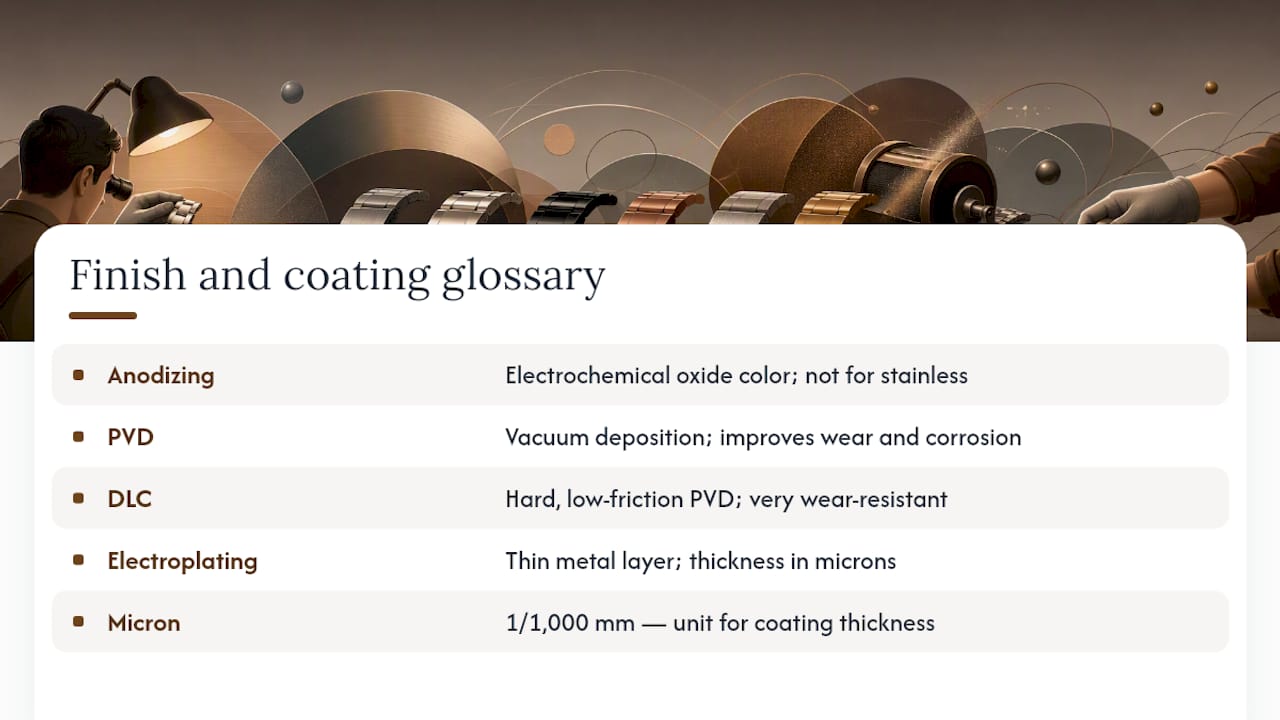
Anodizing: An electrochemical process that thickens the natural oxide layer on titanium or aluminum, producing color without paint or plating. Not applicable to stainless steel.
Bead-blast/sandblast: A mechanical process that propels fine particles at the metal surface to create a uniform matte texture.
Brushed: A mechanical finish created by dragging an abrasive across the metal in one direction, leaving fine parallel lines.
DLC (Diamond-Like Carbon): A hard, low-friction PVD coating in dark gray or black tones. Among the most wear-resistant coatings used on watch bands.
Electroplating: A process that uses electrical current to deposit a thin metal layer (gold, silver, or other) onto a base metal. Thickness is measured in microns; thicker plating lasts longer before wear-through.
IP (Ion Plating): A variant of PVD used in the watch industry. The terms PVD and IP are often used interchangeably in product listings.
Micron: One-thousandth of a millimeter (1/1,000 mm). Coating thickness is stated in microns. Thicker coatings generally last longer.
Mirror-polish: The highest level of mechanical polishing, producing a reflective surface. Requires the most maintenance to keep looking sharp.
Passivation: A chemical treatment (acid bath) that removes free iron from stainless steel surfaces, improving corrosion resistance. Produces no visible change in appearance.
PVD (Physical Vapor Deposition): A vacuum-based process that vaporizes a target material and deposits it as a thin, hard layer on the band. PVD coatings improve wear and corrosion resistance compared with bare metal.
Satin: A low-directional matte finish between brushed and polished in sheen level.
Wizeband’s approach to finished metal bands
Wizeband designs premium 316L stainless steel Apple Watch bands in finished styles including Silver Gold, Starlight, Rose Gold, and Gold, built to wear like jewelry without sacrificing durability. The bands are compatible with Apple Watch Series 4–10, SE, and Ultra 2.
If you want to see how these finishes look in practice, the Wizeband Essentials Bundle and Wizeband Starter Kit are good starting points for first-time buyers choosing a finished metal band. Individual styles like the Tokyo Metal Strap show the finish options and technical details on each product page.

Sources
- How to clean your Apple Watch - Apple Support
- How should I care for my watch band? | Seiko Watch Corporation
- How to clean your smartwatch | The Verge
- Types of Watch Bands - the Watch Bands Wiki | Strapcode
Recommended
Aus dem Blog
Alle anzeigen


Hinterlassen Sie einen Kommentar