


Versatile Watch Band Finishes: Style and Durability Guide
A versatile watch band finish is a surface treatment — brushed, polished, matte, satin, or PVD/DLC coating — chosen to balance how a band looks with how quickly it shows wear. For Apple Watch users who move between desk work, meetings, and weekend plans, the right finish keeps a band looking sharp across all three without constant upkeep. Wizeband builds its metal bands from 316L stainless steel, applying finishes that hold up to daily contact while reading like jewelry on the wrist.
Table of Contents
- What is a versatile watch band finish, exactly?
- How does your daily routine affect which finish holds up?
- Which finishes pair best with your wardrobe?
- How are watch band finishes made, and what does that mean for wear?
- How to care for each finish to keep it looking good
- How to judge finish quality and craftsmanship before you buy
- Pick your finish in under a minute
- Key Takeaways
- The finish choice most people get wrong
- Wizeband metal bands built for real daily wear
What is a versatile watch band finish, exactly?
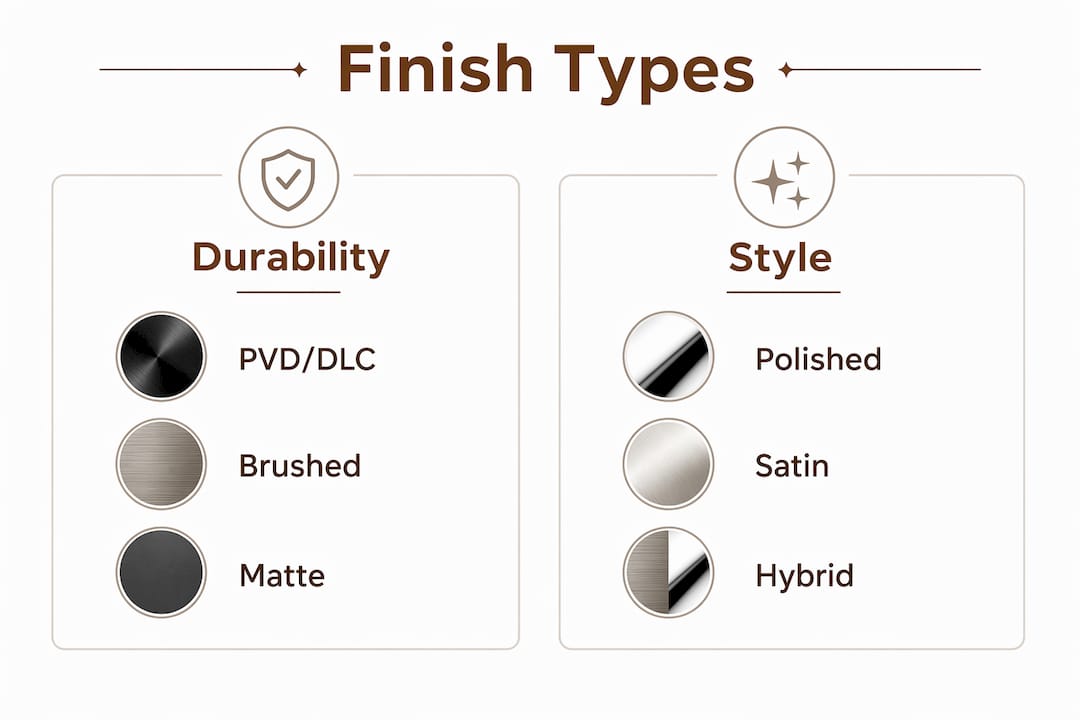
The finish is the final treatment applied to a band’s surface. It defines texture, reflectivity, and durability — the same steel dimensions can look completely different depending on how the surface is treated. A polished finish catches light like a mirror. A brushed finish scatters it softly. A matte or sandblasted surface absorbs it almost entirely.
Here are the main finish types Apple Watch users encounter:
- Polished: High-gloss, mirror-like surface. Looks formal and sharp but shows fingerprints and fine scratches quickly.
- Brushed/satin: Linear grain that softens reflections. Hides minor contact marks better than polished surfaces and needs less frequent cleaning.
- Matte/sandblasted: Flat, low-reflectivity surface. Casual and understated; hides wear well but can look dull in formal settings.
- Bead-blasted: Similar to matte but with a slightly more textured, industrial feel. Common on sport-oriented metal bands.
- PVD/IP coated: A thin physical vapor deposition or ion plating layer adds color (black, gold, rose gold) and improves abrasion resistance over bare steel.
- DLC (diamond-like carbon): A harder coating than standard PVD. Excellent scratch resistance, typically in black or dark gray.
- Two-tone/hybrid: Polished chamfers paired with brushed flanks — the most common combination in quality metal bands. Adds visual depth and hides micro-abrasions on the flat surfaces.
Leather develops a patina over time rather than scratching visibly. Silicone can develop shiny flex spots and collect lint on dark colors. Metal finishes behave differently from both, which is why finish choice matters most on metal and plated bands.
Pro Tip: On polished surfaces, curved edges and chamfers reduce visible scratching compared with large flat polished plates. If you want some gloss without constant maintenance, look for bands with polished chamfers and brushed main surfaces.
How does your daily routine affect which finish holds up?
Desk-heavy users benefit from brushed or matte finishes because keyboard and desk contact creates constant low-level abrasion. Polished surfaces highlight those marks immediately. Active users face a different problem: sweat, gym equipment, and outdoor contact call for coatings that resist both abrasion and corrosion.

| Daily Profile | Best Finish | Why |
|---|---|---|
| Desk/keyboard-heavy | Brushed or satin | Hides contact scuffs; low maintenance |
| Office/meetings | Satin or two-tone hybrid | Refined look; tolerates light wear |
| Active/gym and outdoors | PVD/DLC coated | Abrasion and sweat resistance |
| Travel/events | Polished or hybrid | Visual impact; lower contact frequency |
Use this checklist to identify your profile:
- Do you type for more than four hours a day? Choose brushed or matte.
- Do you attend client meetings or formal events weekly? Consider a hybrid or polished finish.
- Do you wear your watch during workouts or outdoor activities? Prioritize PVD or DLC.
- Do you want one band for everything? A brushed-and-polished hybrid covers the most ground.
One tradeoff worth knowing: PVD and DLC coatings add color options and real abrasion resistance, but heavy impact or sharp abrasion can chip the coating at edges. They are durable under normal wear, not indestructible under abuse.
Pro Tip: If you split time between a desk and the gym, a brushed stainless band handles both better than a polished one. Save the polished finish for a second band you rotate in for events.
Which finishes pair best with your wardrobe?
Finish choice is also a style decision. The surface treatment signals formality just as much as the band material does.
- Formal/event wear: Polished or hybrid (polished chamfers + brushed flanks) reads as dress jewelry. Pairs well with suits, blazers, and evening outfits. Wizeband’s Apple Watch band finish options cover Silver Gold and Gold for exactly this context.
- Business/office: Satin or brushed finishes look refined without demanding attention. Works with business casual, button-downs, and tailored trousers.
- Casual/weekend: Matte metal, textured finishes, or leather straps. A leather strap in brown or tan pairs naturally with jeans, chinos, and relaxed weekend wear.
- Sports/athleisure: Silicone or DLC/PVD-coated metal. Sweat-resistant, easy to wipe down, and visually consistent with athletic gear.
A brushed stainless band in Starlight or Rose Gold sits comfortably between office and weekend wear — formal enough for a Monday meeting, relaxed enough for Saturday brunch. That range is what makes a finish genuinely versatile.
Three quick outfit pairings to visualize the difference:
- Polished Gold + white dress shirt: Reads as a dress watch, not a fitness tracker.
- Brushed Silver + dark jeans and a blazer: Smart-casual without effort.
- DLC black + gym kit or joggers: Clean, sporty, and low-maintenance.
Pro Tip: For women’s Apple Watch styling, Rose Gold and Starlight finishes work across the widest range of outfits. See Wizeband’s stylish bands guide for specific pairing ideas.
How are watch band finishes made, and what does that mean for wear?
Each process produces a different surface at the microscopic level, which is why durability varies so much between finishes.
- Polishing: Abrasive compounds smooth the steel to a mirror surface. Scratches are visible because light reflects uniformly — any disruption shows.
- Brushing: Abrasive strokes in one direction create a linear grain. Light scatters along the grain, masking small marks.
- Sandblasting/bead-blasting: Fine particles hit the surface at high pressure, creating a uniform matte texture. Very forgiving of contact wear.
- PVD/IP plating: A thin metallic layer is deposited in a vacuum chamber. Adds color and a harder surface than bare steel, but the layer is thin — deep abrasion can reach the base metal.
- DLC coating: A carbon-based layer applied over steel. Harder than standard PVD, with better scratch resistance under normal daily use.
316L stainless steel is the standard base metal for quality metal bands. Its corrosion resistance and hardness make it a reliable foundation for any of the above processes.
Mixed finishes — polished chamfers with brushed flanks — are not just aesthetic. They reduce the monotony that makes wear obvious on large flat polished surfaces, while the polished edges catch light and signal quality.
Realistic wear expectations by finish:
| Finish | Scratch Visibility | Wear Rate Under Daily Use |
|---|---|---|
| Polished | High | Shows quickly |
| Brushed/satin | Low | Hides light contact well |
| Matte/sandblasted | Very low | Most forgiving |
| PVD/IP | Low to medium | Durable; can chip at edges |
| DLC | Very low | Best abrasion resistance |
Pro Tip: PVD and DLC coatings on 316L stainless steel offer the best combination of color variety and wear resistance for active users. Check that the coating covers edges and clasp components, not just the main links.
How to care for each finish to keep it looking good
Regular cleaning extends the visible lifespan of any finish. The method depends on the surface.
- Daily: Wipe metal bands with a dry microfiber cloth to remove oils and light dust.
- Weekly: Use a soft cloth with mild soap and warm water. Rinse thoroughly and dry completely before wearing.
- For brushed surfaces: Wipe along the grain direction to avoid cross-grain scratches that disrupt the linear pattern.
- For polished surfaces: Use a jewelry polishing cloth to restore gloss. Avoid abrasive cleaners — they will dull the mirror finish permanently.
- For PVD/DLC coatings: Mild soap and water only. No abrasive pads, no solvents. Solvents can degrade the coating bond over time.
- For leather bands: Wipe with a dry cloth after wear. Apply a light leather conditioner every few months. Keep away from prolonged water exposure.
- For silicone bands: Soap and water. Silicone is the easiest to clean and the most tolerant of cleaning agents.
- Yearly: Inspect clasps, links, and coating edges for chips or wear. A professional jeweler can re-polish stainless steel bands; coated bands that have chipped significantly may need replacement rather than refinishing.
Avoid ultrasonic cleaners on PVD or DLC-coated bands — the vibration can loosen the coating at edges.
How to judge finish quality and craftsmanship before you buy
Good finishing is a visible signal of overall build quality. Here is what to check in product photos or in person:
- Finish evenness: No blotchy areas, uneven sheen, or visible machine marks across the links.
- Grain continuity: On brushed bands, the linear grain should run consistently across every link, not change direction or stop abruptly.
- Chamfer definition: Clean, sharp edges between polished and brushed surfaces indicate precision machining.
- Clasp quality: A butterfly or jewelry-style deployant clasp signals higher build standards than a simple pin buckle. Check that the clasp finish matches the band finish.
- Consistent coloring on plated pieces: On PVD or DLC bands, color should be uniform across links, clasp, and end pieces — no lighter patches at edges.
- No sloppy seams: Link joints should be tight with no visible gaps or misalignment.
Wizeband’s Goran Stainless Band illustrates these cues in practice: 316L stainless steel construction, a butterfly clasp, and a quick-adjust system with consistent finishing across every link. Finishing quality converts a functional object into a style choice — and the details above are how you tell the difference between a band that was finished with care and one that was not.
The clasp is the most-handled part of any band. If the finish on the clasp is inconsistent with the rest of the band, the overall build quality is likely inconsistent too.
Pro Tip: Zoom into product photos and check the link edges. Clean chamfers and consistent grain across every link are the fastest indicators of a well-finished band.
Pick your finish in under a minute
Use these decision rules to narrow your choice fast:
- If you type all day: brushed or matte metal.
- If you attend formal events regularly: polished or hybrid (polished chamfers + brushed flanks).
- If you work out in your watch: PVD/DLC coated metal or silicone.
- If you want one band for office and weekends: brushed stainless in a neutral finish (Silver, Starlight).
- If color matters as much as durability: PVD or DLC coating in black, gold, or rose gold.
- If you prefer a non-metal option for casual wear: leather for smart-casual; silicone for active use.
Decision flow:
- Metal or non-metal? Metal for durability and dress appeal; non-metal for active or casual-only use.
- Within metal: polished (formal, low-contact), brushed (everyday), or coated (active + color)?
- Within coated: PVD for color variety; DLC for maximum scratch resistance.
- Clasp preference: butterfly/deployant for a secure, jewelry-like fit; pin buckle for simplicity.
Pro Tip: A brushed stainless band in a neutral finish covers the most ground for everyday Apple Watch wear. Add a polished or coated band as a second option for events or workouts. Wizeband’s bands for work guide covers office-specific picks in more detail.
| Scenario | Recommended Finish | Band Type |
|---|---|---|
| Desk work, daily wear | Brushed/satin | Metal link |
| Formal events | Polished or hybrid | Metal link |
| Gym and outdoor | PVD/DLC | Metal or silicone |
| Smart-casual, weekend | Brushed or matte | Metal or leather |
| Color-first preference | PVD (gold, rose gold, black) | Metal link |
Key Takeaways
A versatile watch band finish balances visual style and wear visibility, with brushed and hybrid finishes covering the widest range of daily routines for Apple Watch users.
| Point | Details |
|---|---|
| Brushed finishes are the most versatile | They hide contact marks and work across office, casual, and smart-casual settings. |
| Polished finishes suit low-contact, formal use | High gloss looks sharp but shows scratches and fingerprints quickly. |
| PVD/DLC coatings add color and durability | Best for active users; can chip under heavy abrasion at edges. |
| 316L stainless steel is the quality baseline | It supports all major finishing processes and resists corrosion under daily wear. |
| Wizeband for everyday versatility | Wizeband’s metal bands in Starlight, Rose Gold, Silver Gold, and Gold cover brushed, polished, and hybrid finishes on 316L stainless steel. |
The finish choice most people get wrong
Most Apple Watch users default to polished because it looks premium in product photos. That is the wrong call for anyone who wears their watch all day. Polished surfaces are unforgiving — every desk edge, keyboard, and door handle leaves a mark. The band that looks best in the box often looks the worst after two weeks of real use.
Brushed and hybrid finishes are not a compromise. They are the more considered choice. The linear grain on a brushed surface is doing real work, scattering light so that contact marks disappear into the texture. A polished chamfer on the same band catches light at the edge and signals quality without demanding constant upkeep. That combination — brushed flanks, polished edges — is what separates a well-designed band from one that just photographs well.
The other underrated factor is the base material. A PVD coating on low-grade steel will chip and fade faster than a brushed finish on 316L stainless. The finish is only as good as what it is applied to. When you are evaluating a band, check the steel spec first, then the finish. Both matter.
Wizeband metal bands built for real daily wear
Wizeband designs metal Apple Watch bands that wear like everyday accessories and look like jewelry. Every band is built from 316L stainless steel with a butterfly clasp, quick-adjust links, and finishes — Silver Gold, Starlight, Rose Gold, and Gold — that cover brushed, polished, and hybrid surfaces in one lineup. Compatible with Apple Watch Series 4–10, SE, and Ultra 2, with two size groups that remove the guesswork at checkout.
The Wizeband Essentials Bundle is the practical starting point: multiple finishes and band types in one order, so you have the right band for Monday’s meeting and Saturday’s plans. Or start with the Starter Kit for a lower-friction first purchase. Browse the full lineup at wizeband.com.
Recommended
From the blog
View all


Leave a comment