


What Is a Hinged Watch Clasp: A Quick Visual Guide
A hinged watch clasp is a folding metal closure that uses two or more hinged segments to form a continuous loop around your wrist. Unlike a tang buckle, which bends the strap through a single hole, a hinged clasp keeps the band in a closed loop at all times. Choose one when you want a cleaner look, longer strap life, and a more secure fit on metal, ceramic, or premium leather bands.
Key reasons to pick a hinged clasp over a tang buckle:
- Strap preservation: No repeated bending through a single hole, so leather and metal links last longer.
- Even pressure: The folded mechanism distributes tension across the wrist rather than concentrating it at one point.
- Security: Push-button releases and double-lock designs reduce accidental openings.
- Jewelry-like finish: When closed, the clasp sits flush and looks like part of the band itself.
- Compatibility: Available across metal, ceramic, and rubber straps at every price point.
Wizeband’s metal Apple Watch bands are built around this principle, using 316L stainless steel butterfly and jewelry clasps that close flush and hold firm through daily wear.
Table of Contents
- The main types of hinged watch clasps explained
- How a hinged clasp opens, sizes, and closes
- Advantages, disadvantages, and security: are hinged clasps safe?
- How to choose the right hinged clasp for your watch and lifestyle
- How to size and install a hinged clasp on metal and leather bands
- Care and maintenance tips to keep a hinged clasp working smoothly
- Why hinge quality matters: a closer look at Wizeband’s construction
- Key Takeaways
- The clasp is the part most buyers overlook
- Wizeband bands that put these clasps to work
- Useful sources and further reading
The main types of hinged watch clasps explained
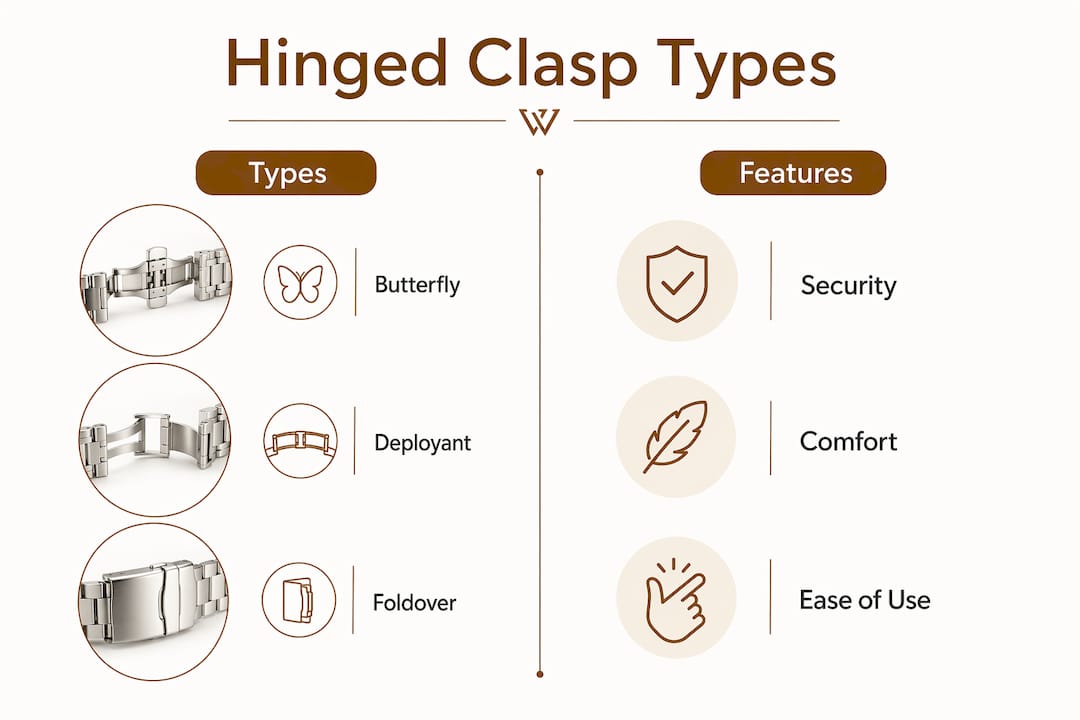
Folding clasps are the most common closure on metal bracelets and come in several distinct styles. Here is a quick breakdown of each type and where it fits best.
- Single-fold (flip clasp): One hinge folds to one side. Simple, lightweight, and common on entry-level metal bands. Some versions include a push-button release.
- Deployant clasp: An asymmetric multi-fold mechanism that attaches to a strap via spring bars. The deployant and butterfly differ mechanically: the deployant folds to one side, while the butterfly opens symmetrically.
- Butterfly (double-fold): Two wings open left and right from a central plate, hiding the mechanism on the underside of the band. Gives the cleanest, most seamless look.
- Foldover with safety (double-lock): A standard fold-over with an added secondary latch or side-button. Preferred for sport and active use.
- Dive extension (ratchet extension): A hinged extension built into the clasp that adds roughly 20–25 mm of bracelet length to fit over a wetsuit. Relevant to ISO 6425 dive watch certification contexts.
- Jewelry/hidden butterfly: Fully concealed when closed. Both hinged components fold inward so the exterior of the bracelet appears uninterrupted.
Quick comparison: hinged clasp types at a glance
| Type | Best for | Security / locking | Ease of use | Comfort / pressure | Material / durability | Aesthetic |
|---|---|---|---|---|---|---|
| Single-fold | Casual / daily metal bands | Friction fit | Easy | Moderate | Steel, base metal | Visible clasp |
| Deployant | Leather straps, dress watches | Push-button optional | Moderate | Good | Steel, gold | Partially visible |
| Butterfly | Dress, jewelry-style bands | Push-button common | Easy once learned | Excellent | Steel, ceramic | Hidden / seamless |
| Double-lock foldover | Sport, active wear | Double-lock + button | Moderate | Good | Stainless steel | Slightly visible |
| Dive extension | Diving, wetsuit wear | Ratchet lock | Moderate | Good | Stainless steel | Functional / visible |
| Jewelry / hidden butterfly | Dress, feminine styles | Friction or push-button | Easy | Excellent | Steel, ceramic | Fully hidden |
How a hinged clasp opens, sizes, and closes
The core mechanic is simple: hinged metal plates fold flat to form a loop, and a latch or push-button locks them in place. Here is how to work a standard deployant or butterfly clasp step by step.
- Locate the release. Find the push-button or thumb-press on the side or face of the clasp. On a butterfly, there are usually two buttons, one on each wing.
- Press and open. Press the button firmly and swing the hinged arm (or both wings) outward until the clasp lies flat. Do not force it if it resists.
- Slide your wrist in. With the clasp open, slip the band over your wrist. The open position should give you enough room to do this comfortably.
- Close the first fold. Bring one hinged arm up and press it toward the center plate until you feel or hear a click. On a single-fold, this is the only step.
- Close the second fold (butterfly). Bring the second wing up and press it into the center plate. Both wings should click into place simultaneously or in quick succession.
- Check alignment. Run your finger along the clasp. It should sit flush with no lateral wobble. A gap or tilt means the hinge arm is not fully seated.
- Test the secondary safety. If the clasp has a double-lock flap or secondary catch, engage it now. Give the band a firm tug to confirm it holds.
Pro Tip: Watch a short video demo of your specific clasp type before your first fitting. The click sound and the feel of full engagement are easier to recognize after you have seen them once.

Advantages, disadvantages, and security: are hinged clasps safe?
Hinged clasps are generally more secure than tang buckles for active use because they distribute tension evenly rather than stressing a single hole. That said, they are not all equal.
Advantages:
- Strap preservation: deployant mechanisms keep the band in a continuous loop, avoiding the hole-wear that shortens leather strap life.
- Easier one-handed operation than a pin buckle once you know the clasp.
- Jewelry-like finish when closed, especially on butterfly and hidden designs.
- Even pressure distribution across the wrist reduces hot spots during long wear.
Disadvantages:
- More mechanical parts mean more potential failure points than a simple buckle.
- Low-quality hinges can feel stiff, develop lateral play, or lose their click over time.
- Added weight may feel noticeable on lightweight rubber or thin leather straps.
Security guidance: Push-button releases and double-lock foldovers are the most reliable options for active use. A two-stage security system (primary fold plus a secondary catch or side-button) adds redundancy against accidental opening during vigorous movement. The main failure modes to watch for are a worn locking pin, a stretched hinge arm, and a secondary latch that no longer engages cleanly.
Pro Tip: If your clasp stops clicking cleanly, check alignment before assuming it is broken. A millimeter-level shift in the hinged arm is the most common cause of a stiff or non-clicking clasp. Gently press the arm back into alignment rather than forcing it closed.
Dive extension reference
| Feature | Specification |
|---|---|
| Typical extension range | 20–25 mm |
| Primary use | Fitting bracelet over a wetsuit |
| Certification context | ISO 6425 dive watch standard |
| Locking mechanism | Ratchet or push-button |
How to choose the right hinged clasp for your watch and lifestyle
The right clasp depends on your watch, your strap material, and how you use it. Watch experts agree that there is no single best option: a butterfly suits a dress watch, while a double-lock foldover is the better call for sport or dive use.
Decision checklist:
- Watch case size and lug width (measure in mm before buying).
- Strap material: metal and ceramic pair naturally with butterfly or deployant; leather works well with a deployant; rubber/silicone suits a single-fold or double-lock.
- Activity level: daily office wear vs. gym, swimming, or diving.
- Preferred look: visible clasp vs. hidden/seamless finish.
- Need for micro-adjust or extension (dive extension adds 20–25 mm).
- Compatibility with your specific Apple Watch series and case size.
Trust signals to look for in a product listing:
- Material spec: 316L stainless steel is the standard for corrosion resistance and long-term durability.
- Solid-link construction rather than hollow links, which flex and wear faster.
- Push-button or double-lock mechanism stated explicitly, not just implied.
- Explicit compatibility notes (series, case size, lug width).
- Warranty or return policy that covers mechanical defects.
Buyer scenarios:
- Dress watch or jewelry-style band: Choose a butterfly or hidden butterfly. The seamless look is the point.
- Fitness or daily active wear: Double-lock foldover with push-button. Security over aesthetics.
- Leather strap for daily wear: A deployant clasp preserves the strap by keeping it in a loop rather than bending it through a hole repeatedly.
- Red flags: Loose lateral play in the hinge, a secondary safety that does not engage, and no material spec listed are all reasons to look elsewhere.
How to size and install a hinged clasp on metal and leather bands
Tools you will need
- Spring-bar tool (for attaching or removing the clasp from spring-bar lugs)
- Link removal tool or pin punch (for metal link bracelets)
- Small flathead screwdriver (for screw-link designs)
- Wizeband’s band link removal tool if you are working with Wizeband metal bands
Metal link bracelet: step-by-step
- Lay the band flat and count the links on each side of the clasp for even sizing.
- Use the link removal tool to push out the pin from the link you want to remove. Work from the arrow direction marked on the link if present.
- Remove the same number of links from each side to keep the clasp centered on the wrist.
- Reattach the end links to the clasp, pressing the pin back in until it seats flush.
- Test the micro-adjust if the clasp has one: slide it one notch tighter and one notch looser to confirm it moves freely.
- Put the band on and close the clasp. Check that it sits centered on the underside of your wrist with no rotation.
Leather or rubber strap: step-by-step
- Confirm the deployant clasp matches your strap’s lug width (typically 18–22 mm for Apple Watch).
- Attach the clasp’s spring-bar end to the strap’s fixed end, pressing the spring bar into the strap’s slot until it clicks.
- Thread the strap’s free end through the clasp’s buckle bar and set the pin in the correct hole for your wrist size.
- Close the clasp and check that the strap end is tucked neatly under the keeper loop.
- Wear it for a few minutes, then recheck fit. Leather stretches slightly; you may need to move one hole tighter after the first day.
Safety note: If a hinge arm feels misaligned and will not close without force, stop. Forcing a misaligned hinge can bend the arm or crack the locking pin. Bring it to a watchmaker for a quick realignment.
Care and maintenance tips to keep a hinged clasp working smoothly
- Wipe after every wear: Salt and sweat accelerate corrosion on metal hinges. A dry microfiber cloth after each use is enough for daily maintenance.
- Rinse occasionally: For 316L stainless steel clasps, a brief rinse under warm water with a drop of mild soap removes buildup in the hinge joints. Dry thoroughly immediately after, including inside the fold.
- Check for play: Once a month, open the clasp and gently test each hinge arm for lateral wobble. A small amount is normal; noticeable slop means a hinge pin is wearing.
- Lubrication: A tiny amount of watch oil or silicone lubricant on the hinge pivot points once or twice a year keeps the action smooth. Avoid general-purpose oils, which can attract dust.
- When to service: Persistent misalignment, a secondary latch that no longer engages, or a hinge arm that bends rather than pivots cleanly are signs to take the clasp to a trained watch technician. Do not attempt to bend a worn hinge arm back into shape at home.
Why hinge quality matters: a closer look at Wizeband’s construction
Hinge quality is something you feel immediately. A well-machined clasp clicks with a single, definitive snap and shows zero lateral play when closed. A poorly made one feels loose, clicks softly or not at all, and develops wobble within months. Higher-end stainless steel mechanisms offer smoother operation and longer life than mass-market stamped parts.
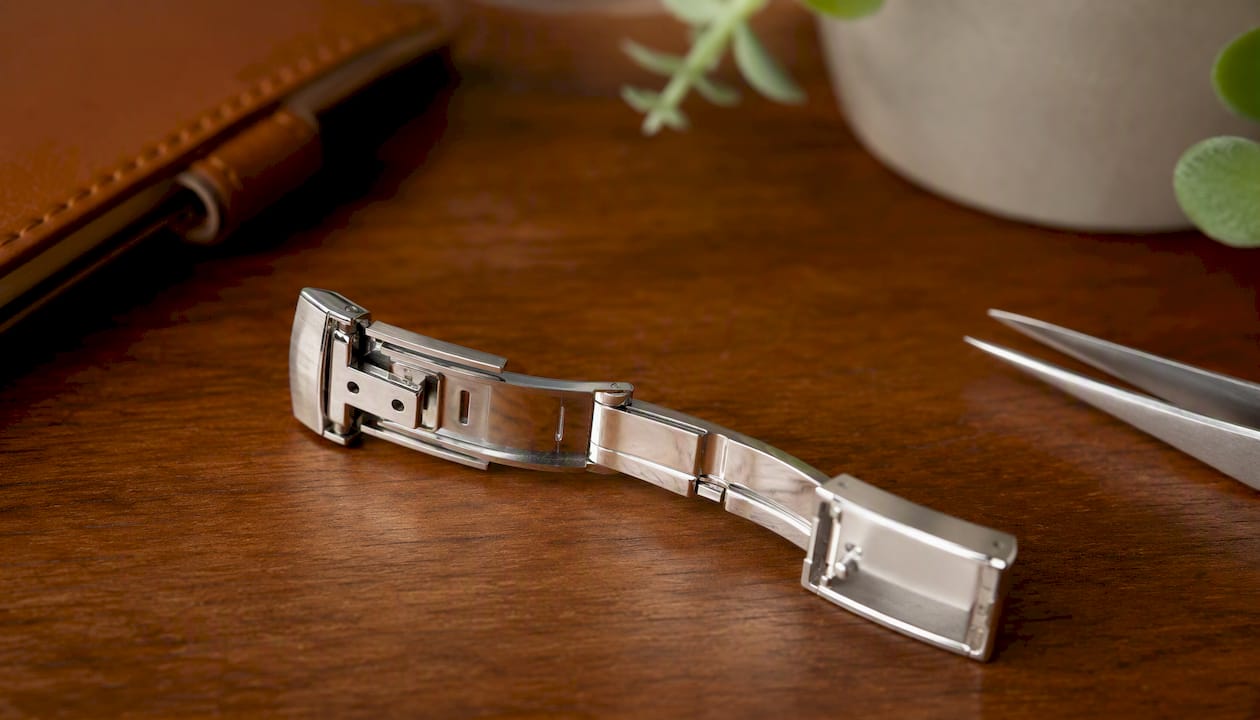
Wizeband builds its metal Apple Watch bands from 316L stainless steel throughout, including the clasp mechanism. That grade of steel resists corrosion from sweat and water, holds its finish longer than lower-grade alloys, and machines to tighter tolerances, which is what produces the crisp click and zero-play feel.
Key proof points across the Wizeband lineup:
- Butterfly and jewelry clasps on bands like the Neos and Daphne use the hidden double-fold design, so the exterior of the band looks uninterrupted.
- Deployant-style construction on bands like the Gaia and Goran provides solid-link construction with quick-adjust sizing.
- Ceramic compatibility: The Kleio ceramic band pairs ceramic links with a stainless clasp mechanism, combining material durability with hinge precision.
- Apple Watch Series 4–10, SE, and Ultra 2 compatibility is confirmed across the lineup, with two size groups to simplify ordering.
Key Takeaways
A hinged watch clasp is the most secure and strap-friendly closure for metal, ceramic, and premium leather bands, with butterfly and double-lock designs offering the best combination of security and comfort.
| Point | Details |
|---|---|
| Definition | A hinged clasp uses folding metal segments to form a continuous loop, unlike a tang buckle. |
| Best security option | Double-lock foldover or butterfly with push-button reduces accidental opening for active wear. |
| Dive extension range | A ratchet extension clasp adds bracelet length to fit over wetsuits. |
| Top maintenance tip | Wipe after every wear and check hinge play monthly; service a failing latch promptly. |
| Wizeband option | Wizeband’s 316L stainless steel bands use butterfly and jewelry clasps with quick-adjust sizing for Apple Watch Series 4–10, SE, and Ultra 2. |
The clasp is the part most buyers overlook
Most people shopping for a watch band focus on color, finish, and price. The clasp gets a glance at best. That is a mistake. The clasp is the one component that engages and disengages every single day, and it is the first thing to show wear. A band with a beautiful finish and a poorly machined hinge will feel loose and unreliable within a year.
The other thing buyers underestimate is how much the clasp type affects daily comfort. A butterfly clasp that sits flush and hidden changes the feel of wearing a metal band entirely. It stops feeling like a watch and starts feeling like a bracelet. That shift matters more than most spec sheets suggest.
Match the clasp to how you actually use the watch. A hidden butterfly for a dress or jewelry look. A double-lock foldover when you need security during movement. A deployant on leather when you want the strap to last. Get the click right, check the alignment, and the rest of the band takes care of itself.
Wizeband bands that put these clasps to work
If you want a ready example of butterfly and deployant clasp quality on an Apple Watch band, Wizeband’s metal lineup covers the main use cases discussed above.
The Gaia Metal Strap and Goran Stainless Band are solid-link deployant-style options built for daily wear. The Nete Stainless Band and Daphne use hidden butterfly clasps for a jewelry finish. Every band is made from 316L stainless steel, fits Apple Watch Series 4–10, SE, and Ultra 2, and comes in two size groups so you skip the guesswork at checkout. A band link removal tool is available if you want to size the links at home.
Not sure where to start? The Wizeband Essentials Bundle gives you a curated set of bands across clasp styles so you can compare the feel of a butterfly versus a deployant on your own wrist before committing to one style.
Useful sources and further reading
- Watch Clasps Guide: Types, Features & Adjustments — Rotate Watches. Covers clasp taxonomy, hinge quality, and strap preservation in detail.
- Watch Clasp Types Explained: A Complete Style Guide — WatchBook. Includes the dive-extension 20–25 mm figure and ISO 6425 context.
- Watch Clasp Types Explained: Tang Buckle, Deployment, Butterfly, and More — Watch Police. Good on the mechanical differences between deployant and butterfly, and lifestyle-based selection advice.
- 12 Types of Watch Clasps and Fastening Mechanisms — Strapcode. Detailed breakdown of flip clasps, butterfly variants, and spring-bar attachment methods.
- Watch Clasps 101 — Teddy Baldassarre. Clear explanations of folding clasp mechanics and the pros and cons of each type.
- The Ultimate Guide to Watch Clasps — Horbiter. Covers material and price-point variation across clasp types.
- How to Open and Close Hinged Jewelry Safely — Velani Jewelry. Useful for the alignment diagnostic tip on stiff or non-clicking hinges.
- Wizeband Metal Apple Watch Bands — Wizeband. Product landing page for readers ready to shop butterfly and deployant clasp options for Apple Watch.
Recommended
Aus dem Blog
Alle anzeigen


Hinterlassen Sie einen Kommentar