


Types of Jewelry Style Watch Bands: Your Complete Guide
Jewelry-style watch bands transform a smartwatch from a tech device into a genuine accessory. The main types of jewelry style watch bands include metal link bracelets (Oyster, Jubilee, President, and Engineer styles), mesh or Milanese bands, multi-chain and layered bracelet designs, and leather bands with decorative hardware. Each type serves a different style purpose, from everyday polish to formal elegance. Design elements like butterfly clasps and polished link patterns are what separate these bands from purely functional straps.
Key categories at a glance:
- Metal link bracelets: Oyster, Jubilee, President, Engineer styles in stainless steel, gold, or rose gold
- Mesh (Milanese) bands: Tightly woven metal links with a flexible, chainmail-like construction
- Multi-chain and layered styles: Designed to stack like bracelets, functioning as jewelry centerpieces
- Leather bands with jewelry elements: Decorative clasps, exotic finishes, and metal hardware
- Butterfly clasp bands: Clean, secure closures that add a refined, seamless look
Industry style guides confirm that watch bands now function as versatile accessories, shifting smartwatches from sport to sophistication with a simple swap.
What is the difference between a watch band, strap, and bracelet?
These three terms get used interchangeably, but they mean different things. Understanding the distinction helps you shop and style more confidently.

A watch band is the broadest term. It covers any wrist attachment, regardless of material, metal or non-metal. A watch strap refers specifically to non-metal options: leather, nylon, rubber, sailcloth, or fabric. A watch bracelet means a metal construction with interlocking links, such as stainless steel, titanium, or precious metal designs like Oyster or Jubilee.
For jewelry-style purposes, the bracelet category is the most relevant. Metal bracelets carry the visual weight and finish of fine jewelry. Leather straps with decorative hardware sit in a middle ground, blending strap comfort with bracelet-level elegance. Knowing which category you are shopping in makes it easier to match a band to an outfit or occasion.
Common types of jewelry-style watch bands
Metal link bracelets
Metal link bracelets are the closest a watch band gets to traditional jewelry. The four most recognized styles each have a distinct look and feel.
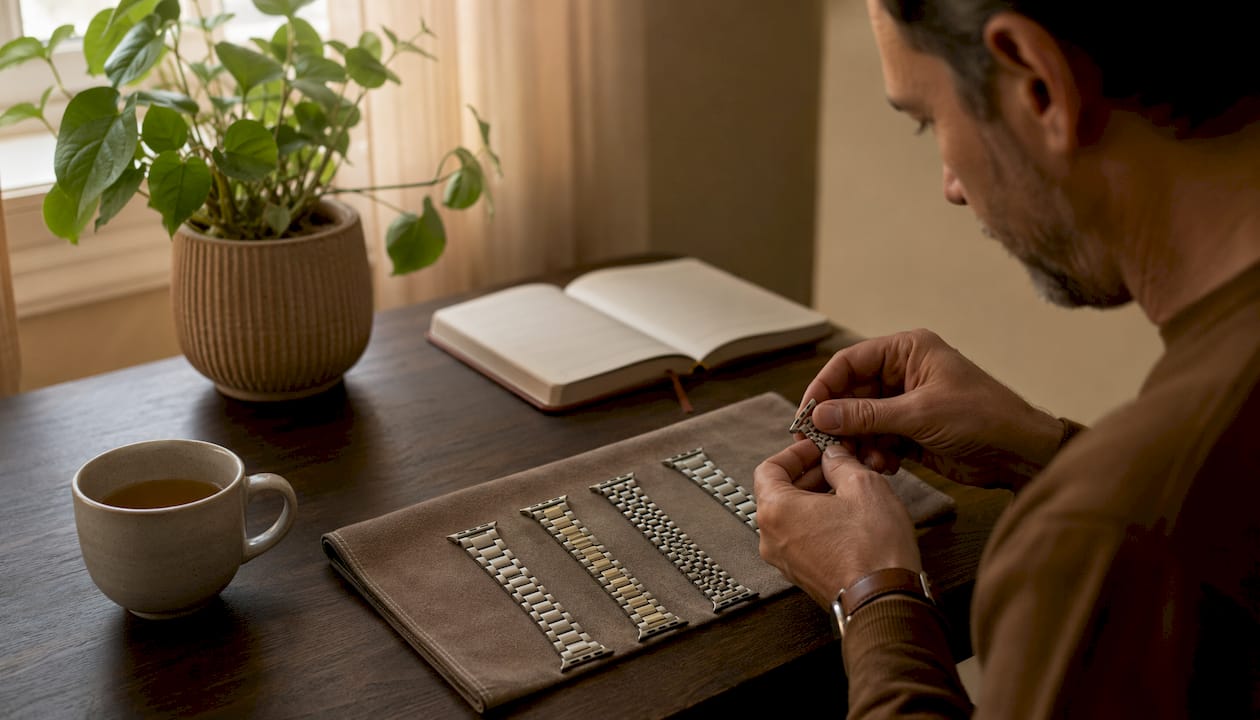
Oyster: Three-piece links with a wide center bar. Known for durability and a solid, substantial feel on the wrist. The construction makes each link more resistant to wear, though the band can feel slightly stiff compared to finer styles.
Jubilee: A five-piece link design with three smaller polished center links flanked by two larger brushed outer links. The result is a refined, dressy appearance that works on both small and large watch cases. The Jubilee is widely considered the most elegant of the standard metal bracelet styles.
President: Shorter, denser links of similar width to the Oyster, but with more total links. More versatile than the Oyster for smaller or medium-sized watches, and carries a status-forward aesthetic.
Engineer: Five links across the width, often cut in a hexagonal pattern. The angular look reads as sporty and bold. Originally designed for dive watches, the Engineer style pairs well with larger, more technical watch cases.
Key features shared across metal link bracelets:
- Polished, brushed, or mixed-finish surfaces
- Removable links for custom sizing
- Butterfly or fold-over clasps for secure wear
- Compatible with both dress and casual outfits
Mesh (Milanese) bands
Milanese mesh bands originated in Milan, with roots tracing back to 13th-century chainmail craftsmanship. The design features tightly woven metal wires that create a smooth, flexible surface. On the wrist, the result is a band that drapes rather than sits, conforming to wrist contours with a comfort that rigid link bracelets cannot match.
The aesthetic is distinctly vintage-elegant. Milanese bands catch light across their entire surface, giving them a shimmer that reads as jewelry rather than hardware. They adjust via a slide-lock mechanism, which means no fixed holes and a precise fit every time.
Defining features:
- Woven metal wire construction (usually stainless steel)
- Flexible and breathable
- Slide-lock or magnetic closure
- Vintage-inspired appearance with modern comfort
Multi-chain and layered bracelet styles
Multi-chain bands are designed from the start to function as jewelry. Rather than a single bracelet-style band, these styles feature two, three, or four parallel chains connecting the watch case to the clasp. The visual effect mimics a stacked bracelet look without requiring you to actually layer multiple pieces.
These bands are particularly popular for styling an Apple Watch as jewelry. The chains create movement and dimension on the wrist, and they pair naturally with other bangles or cuff bracelets. Wizeband’s quadruple-chain designs are a direct example of this category, built specifically for wearers who want their watch to read as an accessory first.
Leather bands with jewelry elements
Leather bands with metal detailing occupy a distinct space in the jewelry-style category. The base material is traditional leather, but decorative hardware, exotic finishes, and jewelry-grade clasps push these bands into accessory territory. Think gold-tone buckles, pavé-crystal accents, or alligator-embossed leather with a polished deployment clasp.
These bands work especially well for formal occasions where a full metal bracelet might feel too heavy. The leather provides lightness and comfort; the hardware provides the jewelry effect.
Materials used in jewelry-style watch bands
Material choice drives both the look and the long-term wearability of a jewelry-style band. The table below covers the main options across the criteria that matter most for accessorizing.
| Material | Style/Design | Durability | Comfort | Compatibility |
|---|---|---|---|---|
| 316L stainless steel | Polished, dressy, versatile | Very high; corrosion-resistant | Moderate; heavier than leather | Apple Watch, most smartwatches |
| Gold-plated steel | Warm, luxury appearance | High with care; plating can wear | Moderate | Apple Watch, dress watches |
| Rose gold steel | Feminine, warm tone | High with care | Moderate | Apple Watch, fashion watches |
| Titanium | Sleek, modern, lightweight | Very high; scratch-resistant | High; lightest metal option | Premium smartwatches |
| Leather (with hardware) | Classic, formal, varied | Moderate; needs conditioning | High; soft and flexible | Universal |
| Nylon/fabric | Casual, sporty | High; washable | Very high; breathable | Universal |
316L stainless steel is the standard for premium jewelry-style bands. It resists corrosion, holds a polished finish well, and is hypoallergenic, which matters for daily wear. Gold and rose gold finishes are typically applied over a stainless steel base, giving the warm color of precious metal without the cost or weight.
Titanium is lighter than steel and highly scratch-resistant, making it a strong choice for wearers who want a metal band without the weight. Leather remains the go-to for formal occasions where comfort takes priority over the full metal look.
Butterfly clasps appear across metal and leather bands alike. The mechanism folds flat against the wrist and opens with a press on both sides, providing a secure hold with a clean, uninterrupted surface. For jewelry-style bands, the butterfly clasp is the preferred closure because it maintains the band’s visual line without a visible buckle interrupting the design.
How to choose the right jewelry-style watch band for style and comfort
Choosing a band comes down to four practical factors: occasion, wrist size, personal style, and the watch’s compatibility specs.
Occasion: Metal link bracelets and Milanese bands suit office and formal settings. Multi-chain styles work for evenings out or casual days when you want your watch to read as jewelry. Leather with hardware bridges the gap for events where you want polish without the weight of a full metal bracelet.
Wrist size: Bands with removable links (Oyster, Jubilee, President styles) adjust to fit precisely. Milanese bands adjust continuously via their slide mechanism. Multi-chain styles and cuff designs tend to have fixed sizing, so checking measurements before buying matters.
Compatibility: Apple Watch bands attach via a proprietary lug system. Bands designed for Series 4 and later fit Series 4–10, SE, and Ultra 2 in two size groups (38/40/41mm and 42/44/45/49mm). Always confirm the size group before purchasing.
Personal style: Match metal finishes across your accessories. Silver-tone bands pair with silver rings and earrings; gold and rose gold coordinate with warm-toned jewelry. Mixing metals intentionally (a two-tone band with mixed-metal jewelry) reads as modern rather than mismatched, as long as the combination is deliberate.
Factors to evaluate before buying:
- Occasion and dress code
- Wrist circumference and band adjustment range
- Metal finish and how it coordinates with existing jewelry
- Clasp type and ease of daily use
- Maintenance requirements for the material
Pro Tip: Stack a slim Milanese band with one or two thin bangles on the same wrist for a layered look that reads as intentional jewelry styling rather than an accessory pile-up. Keep the metals consistent for the cleanest result.
Wizeband’s premium jewelry-style Apple Watch bands
Wizeband has specialized in premium metal Apple Watch bands since 2016, building a lineup designed specifically for wearers who want their watch to function as jewelry. Every band uses 316L stainless steel construction with polished link designs, butterfly clasps, and quick-adjust systems for a custom fit without tools.
The range covers five band families. Classic metal straps offer the clean, link-bracelet look in Silver Gold, Starlight, Rose Gold, and Gold finishes. The quadruple-chain styles are built for layered bracelet stacking, with four parallel chains that create movement and a distinctly jewelry-forward profile. Butterfly clasp bands prioritize the seamless closure that keeps the band’s visual line unbroken. Premium link bands offer the weight and presence of a traditional metal bracelet.
All Wizeband bands fit Apple Watch Series 4–10, SE, and Ultra 2, offered in two size groups to remove guesswork at checkout. For wearers exploring feminine Apple Watch band styles, the Rose Gold and Gold finishes in the multi-chain and butterfly clasp families are the most popular choices. The Aura Metal Band is a strong starting point for anyone new to jewelry-style bands, combining a polished link design with an accessible price point and broad outfit compatibility.
How jewelry-style watch bands evolved over time
The history of jewelry-style watch bands runs parallel to the history of wristwatches themselves. In the early 1900s, women began wearing wristwatches attached with ornate metal chains and bracelets, treating the watch as a piece of jewelry rather than a tool. That fusion of timekeeping and adornment set the template for everything that followed.
Through the mid-20th century, metal bracelets like the Oyster and Jubilee became status markers, associated with precision engineering and luxury positioning. The Milanese mesh, with its Renaissance-era origins in Milanese goldsmithing, gained mainstream popularity in the 1920s when German manufacturers Staib and Vollmer began producing it at scale.
The arrival of the Apple Watch in 2015 reopened the jewelry-style band conversation for a new generation. Smartwatch wearers quickly discovered that swapping the default sport band for a metal bracelet or mesh band changed the entire character of the device. By the early 2020s, “smart stacking” had become a recognized styling approach, with the watch band treated as the anchor piece in a layered bracelet arrangement.
Care and maintenance for jewelry-style watch bands
Metal bands and leather bands require different care routines, and skipping maintenance shortens both their lifespan and their appearance.
For metal bands (stainless steel, gold-plated, titanium): Wipe down with a soft, lint-free cloth after daily wear to remove oils and moisture. For a deeper clean, use warm water with a small amount of mild dish soap and a soft-bristle brush to work into the links, then rinse and dry thoroughly. Avoid abrasive cleaners, which scratch polished surfaces. Gold-plated bands benefit from occasional polishing with a jewelry cloth to restore their finish.
For leather bands: Condition the leather every few months with a leather conditioner to prevent cracking and drying. Keep leather bands away from water and prolonged sweat exposure. A damp cloth handles surface dirt; soaking or submerging a leather band damages the interior lining quickly.
For mesh (Milanese) bands: The woven construction traps debris easily. A soft brush and warm soapy water clear the mesh effectively. Rinse well and air-dry flat to prevent any warping of the weave.
General rules that apply across all jewelry-style bands:
- Remove the band before swimming, showering, or applying perfume or lotion
- Store metal bands flat or coiled loosely to avoid stress on the links
- Check clasp mechanisms periodically for smooth operation
- Inspect link pins on adjustable bracelets for any signs of loosening
Current trends in jewelry-style watch bands
The dominant trend in 2026 is the bracelet stack. Wearers layer their watch band with two or three complementary bracelets on the same wrist, treating the entire arrangement as a single accessory statement. Thin chains, beaded bracelets, and slim bangles all work alongside metal watch bands without overwhelming the wrist.
Two-tone and mixed-metal finishes have moved from niche to mainstream. A band that combines brushed silver links with gold-tone accents coordinates with both warm and cool jewelry, removing the need to swap bands when switching between gold and silver accessories.
Feminine and delicate designs are growing in demand, particularly for Apple Watch users. Multi-chain styles, pavé-crystal accents, and slim link profiles all reflect a shift away from the chunky sport aesthetic toward something closer to fine jewelry. Rose gold remains the most popular finish in this category, followed by classic gold and two-tone combinations.
Cuff-style bands, which wrap around the wrist as a single rigid or semi-rigid piece rather than a linked bracelet, are gaining traction as a bolder alternative. They read more like a statement cuff bracelet than a watch band, which appeals to wearers who want maximum jewelry impact.
Key Takeaways
Jewelry-style watch bands work best when material, clasp design, and finish are chosen together as a coordinated accessory decision rather than a hardware upgrade.
| Point | Details |
|---|---|
| Main band types | Metal link bracelets, Milanese mesh, multi-chain styles, and leather bands with decorative hardware represent the key jewelry-style watch band options. |
| Material matters | 316L stainless steel is the preferred material for jewelry-style watch bands, offering durability, corrosion resistance, and a polished finish that suits daily wear. |
| Butterfly clasps | Butterfly clasps are a common design element in jewelry-style watch bands, providing a secure and seamless clasp mechanism that enhances elegance. |
| Styling approach | Match metal finishes across all wrist accessories; deliberate two-tone mixing reads as modern, not mismatched. |
| Care by material | Metal bands need periodic polishing; leather bands need conditioning and must stay dry to maintain their appearance. |
Recommended
From the blog
View all


Leave a comment