


Precision-Fit Watch Band for Apple Watch: 2026 Guide
A precision-fit watch band is defined as a strap engineered to match the exact lug dimensions and curvature of a watch case, creating a gap-free, fully integrated connection between band and watch body. For Apple Watch users, this matters more than most people realize. The right band does not just look better. It keeps optical sensors in consistent contact with your skin, reduces pressure points, and prevents the band from rotating during activity. This guide covers what makes a watch band precision-fit, why fit affects sensor accuracy, and how to choose the correct band for your Apple Watch model.
What is a precision-fit watch band, and how is it different?
A precision-fit watch band is engineered with exact lug dimensions and specialized end links that extend the watch case geometry rather than simply attaching to it. Standard bands attach at the lugs but leave visible gaps between the band and case. A precision-fit band eliminates those gaps entirely.
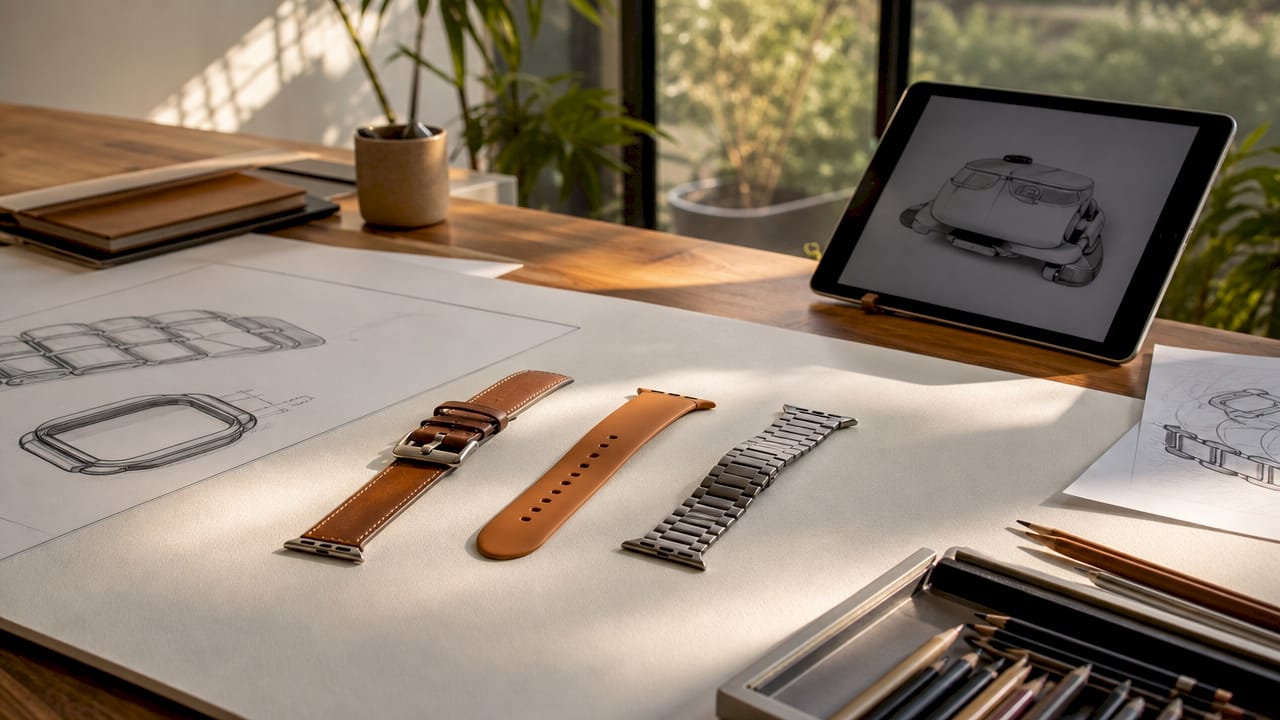
The term “precision-fit” is a descriptive label used widely in retail and watch communities. The recognized industry term for the underlying concept is “integrated strap design,” which refers to bands built to match the specific case profile of a given watch. Both terms describe the same engineering goal: a band that looks and feels like part of the watch, not an accessory bolted onto it.
Apple’s own band ecosystem uses this principle. Compatible bands for Apple Watch are designed around specific lug widths and case profiles for each series, which is why a band built for Series 4 fits Series 10 but not an older Series 3. The geometry is consistent within a defined range, and precision-fit bands are built to that specification exactly.
What makes a watch band precision-fit? Key design features
The most critical component is the end link. End link curvature must match the exact curve of the watch lugs to prevent gaps and poking edges. A poorly shaped end link creates a visible step between the case and band, which looks unfinished and causes skin irritation at the wrist edge.
Beyond end links, three additional design elements define a precision-fit band:
- Lug width tolerance. The band connector must fit the lug gap with minimal play. Loose connectors allow the band to shift laterally, which rotates the watch face off-center during wear.
- Strap tapering. A well-engineered band tapers from the lug width toward the clasp. This distributes pressure evenly and prevents the band from feeling stiff or blocky at the wrist.
- Clasp profile. Properly designed clasps sit flush under the wrist and eliminate pinch points. Butterfly clasps and jewelry-style clasps perform better here than simple pin-and-tuck designs because they fold flat against the skin.
Pro Tip: When evaluating a band, press the end link against the case before buying. If you see a gap wider than 0.5mm or feel a sharp edge, the end link geometry does not match your watch case.
The difference between a standard band and a precision-fit band shows up immediately in daily wear. Standard bands often shift, rotate, and leave red marks. Precision-fit bands stay put.
How does band fit affect sensor accuracy and comfort?
Fit directly affects how well your Apple Watch reads your heart rate. Bands that fit too loosely during fitness activities can cause heart rate measurement errors of 20–30 BPM because disrupted sensor contact introduces inaccuracies. That is a significant margin. A reading that is 25 BPM off can push you into the wrong training zone or mask an actual cardiac event.
“Fitness tracking accuracy heavily depends on consistent skin contact, making precision-fit bands vital for reliable heart rate monitoring. A band that shifts even a few millimeters during a run breaks the optical sensor’s contact with the skin, and the watch compensates by generating estimated readings rather than measured ones.”
The comfort case is equally strong. Custom-engineered bands reduce pressure points by distributing the watch head’s weight evenly across wrist contours and preventing rotation or pinching. This matters most during long wear periods. A band that concentrates pressure at one point causes the familiar red ring that appears after a full day of wear.
Incorrectly fitted bands that move excessively or pinch degrade sensor performance during daily wear, not just during exercise. Every time the watch shifts, the green LED sensors on the back of the case lose their calibrated position against your skin. Precision fit keeps that position locked in.
How to measure and choose the right band for your Apple Watch
Getting the right band starts with knowing your Apple Watch size. Apple Watch bands fall into two lug width groups: 38/40/41mm and 42/44/45/49mm. Every band built for one group fits all models in that group, regardless of series.
Follow these steps to choose correctly:
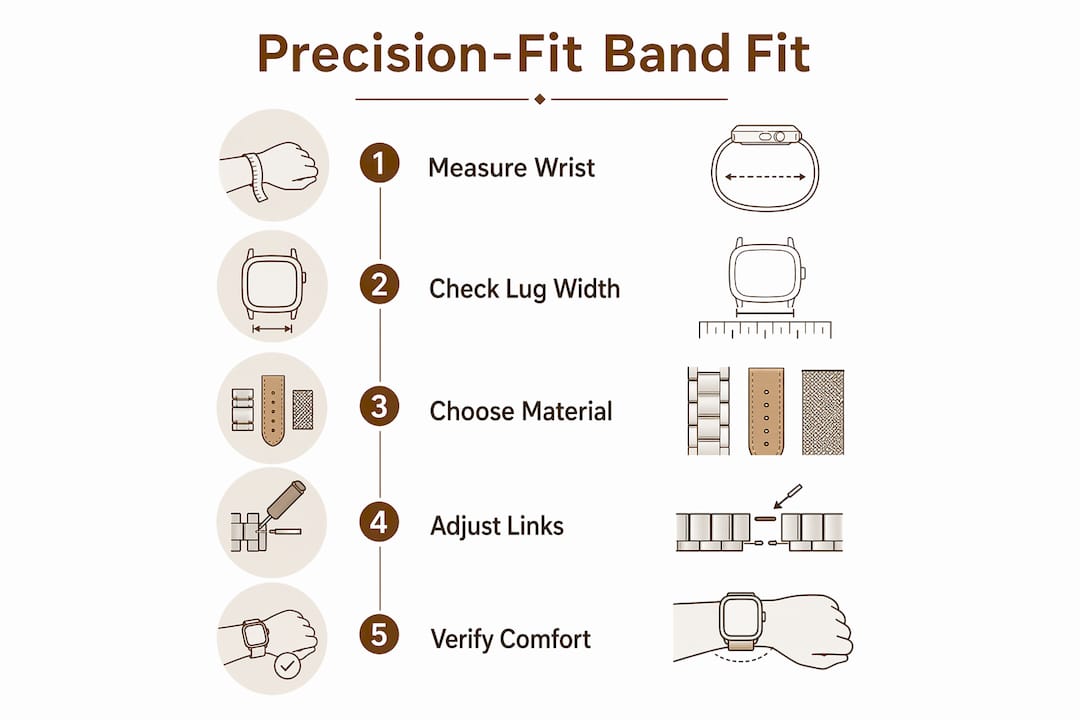
- Identify your Apple Watch model and case size. Check Settings > General > About on your watch, or look at the back of the case. The size is engraved there.
- Measure your wrist circumference. Use a flexible tape measure or a strip of paper around the narrowest part of your wrist. Note the measurement in millimeters.
- Check the band’s length range. Most bands list a wrist circumference range they fit. Match your measurement to that range before ordering.
- Verify lug compatibility. Confirm the band is listed as compatible with your specific Apple Watch series. Measuring lug width accurately and using a sizing tool removes guesswork entirely.
- Adjust link count if needed. Metal link bands require link removal to fit precisely. Use a link removal tool and remove links from both sides of the clasp equally to keep the clasp centered on your wrist.
| Apple Watch size | Lug width group | Typical wrist range |
|---|---|---|
| 38mm / 40mm / 41mm | Small/Medium | 130–200mm |
| 42mm / 44mm / 45mm / 49mm | Large/Extra Large | 150–220mm |
Pro Tip: Always remove links from both sides of the clasp, not just one. Removing from one side only shifts the clasp off-center, which creates uneven pressure and makes the watch feel heavier on one side of your wrist.
What materials and styles work best for precision-fit bands?
Material choice determines how well a precision-fit band performs in specific situations. Each material has real trade-offs.
- 316L stainless steel. The most durable option for daily wear. Stainless steel holds its shape under pressure, which means end links maintain their curvature over time. Wizeband’s metal bands use 316L stainless steel with butterfly clasps and quick-adjust link systems, available in Silver Gold, Starlight, Rose Gold, and Gold finishes.
- Leather. Leather precision-fit bands conform to wrist shape over time, which improves comfort with use. The trade-off is that leather degrades with sweat and moisture, making it a poor choice for fitness use.
- Silicone. Silicone bands offer flexibility and moisture resistance, making them the best choice for workouts and outdoor activities. A silicone precision-fit band maintains sensor contact well during movement because the material grips the skin without sliding.
- Metal blends and plated alloys. These offer the look of stainless steel at a lower price point, but plating wears through over time. For long-term precision fit integrity, solid stainless steel outperforms plated alternatives.
Precision-fit bands come in a wide range of materials, and the right choice depends on your primary use case. For dress and daily wear, stainless steel or leather works best. For fitness and outdoor use, silicone or a lightweight metal band with a secure clasp performs better.
Modern precision-fit production uses 3D scanning and CAD modeling to prototype bands digitally before manufacturing. This process ensures end link curvature, taper angles, and clasp profiles are correct before a single unit is produced. The result is a band that fits correctly out of the box rather than requiring modification.
Key Takeaways
A precision-fit watch band improves comfort, sensor accuracy, and aesthetics by matching the exact lug geometry of your Apple Watch case.
| Point | Details |
|---|---|
| Definition matters | Precision-fit bands use exact end link curvature to eliminate gaps between band and case. |
| Sensor accuracy depends on fit | Loose bands cause heart rate errors of 20–30 BPM by breaking optical sensor contact. |
| Measure before you buy | Match your wrist circumference to the band’s listed range and confirm lug group compatibility. |
| Material affects performance | Stainless steel suits daily wear; silicone suits fitness; leather suits dress occasions. |
| Adjust links evenly | Remove links from both sides of the clasp to keep it centered and pressure balanced. |
Why I think most people underestimate the fit question
Most Apple Watch buyers spend real time choosing the watch face and apps, then grab whatever band looks good in a photo. I understand the logic. The band seems like a minor detail. After wearing precision-fit metal bands daily for years, I can tell you the fit question is not minor at all.
The difference shows up within the first hour. A band that shifts even slightly during a workout produces heart rate data you cannot trust. I have seen workout summaries where the average heart rate was clearly wrong because the band had rotated during a run. That data goes into your fitness history and skews your training zones for weeks.
The comfort difference is just as real. A band that concentrates pressure at one point leaves a mark by noon. A precision-fit band distributes the weight of the watch head across a wider area, and you stop noticing you are wearing it. That is the goal.
Investing in a well-engineered band is not about aesthetics alone. It is about getting accurate data from a device you paid several hundred dollars for. The band is the interface between the watch and your body. Getting that interface right makes everything else the watch does more reliable.
— John
Wizeband’s precision-fit bands and sizing tools
Wizeband has designed precision-fit Apple Watch bands since 2016, with every band built for Apple Watch Series 4–10, SE, and Ultra 2. The lineup covers two size groups, so you select by case size rather than guessing at compatibility.
The Wizeband Essentials Bundle and Wizeband Starter Kit are the best starting points for first-time buyers. Both include bands and the tools needed to adjust link count for a precise fit. Wizeband’s metal bands use 316L stainless steel with butterfly clasps and quick-adjust systems, available in Silver Gold, Starlight, Rose Gold, and Gold. For customers who want to measure before ordering, the band sizing tool guides you through wrist measurement and link adjustment step by step.
FAQ
What is a precision-fit watch band?
A precision-fit watch band is a strap engineered with exact end link dimensions and lug curvature to connect seamlessly with a specific watch case, eliminating gaps and integrating with the watch’s geometry.
How does band fit affect Apple Watch heart rate accuracy?
Loose bands can cause heart rate errors of 20–30 BPM by breaking the optical sensor’s contact with your skin. A snug, stable fit keeps the sensor in consistent contact for accurate readings.
What lug width do I need for my Apple Watch?
Apple Watch bands use two lug groups: 38/40/41mm cases use the small/medium group, and 42/44/45/49mm cases use the large/extra large group. Every band built for one group fits all models in that group.
What material is best for a precision-fit Apple Watch band?
316L stainless steel is the best choice for daily wear because it holds its shape and maintains end link curvature over time. Silicone works best for fitness use because it grips the skin and resists moisture.
How do I adjust a metal link band for a precise fit?
Remove links from both sides of the clasp equally using a link removal tool. This keeps the clasp centered on your wrist and distributes the watch’s weight evenly across both sides.
Recommended
From the blog
View all


Leave a comment