


What Is Premium Strap Construction for Apple Watch?
A premium strap construction is a band built so that its materials, joints, and hardware work together to deliver a jewelry-like fit, finish, and durability on an Apple Watch. Wizeband uses 316L stainless steel with solid metal links, butterfly and jewelry clasps, and quick-adjust systems as its construction standard. That combination is what separates a band that looks like an accessory from one that looks like it belongs on your wrist.
Quick proof points to check in any product photo:
- Solid vs. folded links: Solid links have a consistent cross-section visible at the end grain. Folded links show a seam or hollow edge.
- End link fit: Curved end links sit flush against the Apple Watch case. Flat generic ends leave a visible gap.
- Clasp type: A butterfly or jewelry clasp hides all hardware when closed. A plain pin buckle does not.
- Connector fit: The lug adapter should snap cleanly with no wobble.
TL;DR: Check the end links, clasp, and link grain in product photos before you buy. If the seller cannot show you those details, ask.
Table of Contents
- What makes a strap construction premium?
- What materials are used in high-quality strap construction?
- How does construction affect comfort and long-term value?
- How do you inspect a strap for premium quality?
- How do you size a premium metal Apple Watch band?
- How do you care for a premium metal or ceramic band?
- How Wizeband meets the premium construction standard
- Key Takeaways
- Why construction details are worth your attention
- Wizeband bands that meet this standard
- Useful sources
What makes a strap construction premium?
Every part of a metal Apple Watch band contributes to whether it reads as jewelry or as a generic accessory. Here is what each component does.
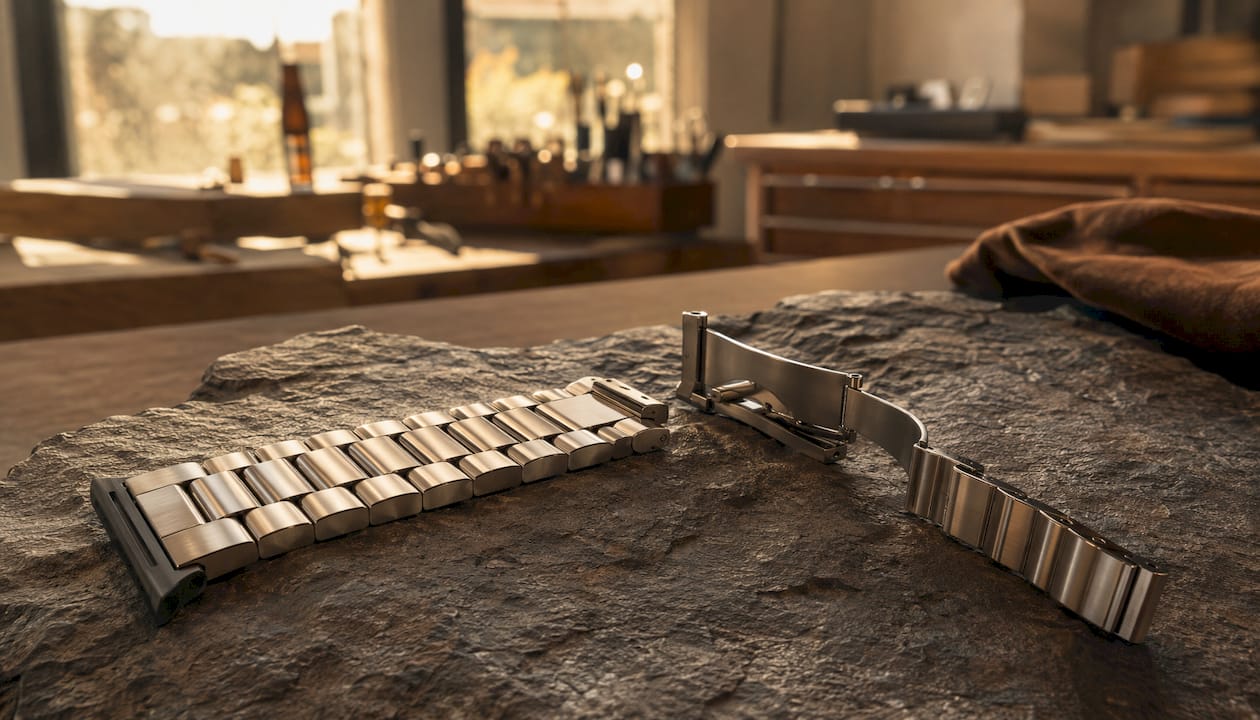
Solid vs. folded links are the single clearest quality signal. Solid links are machined from a single piece of metal. They feel heavier, move quietly, and show a clean cross-section at the end grain. Folded links are stamped from sheet metal and bent into shape. They are lighter and cheaper to produce, and you can usually spot the seam along the edge.
End links and case fit matter more than most buyers expect. A curved end link is shaped to follow the contour of the Apple Watch case, so the band flows into the watch rather than sitting away from it. Generic flat ends create a visible gap that undermines the jewelry look regardless of how good the rest of the band is.
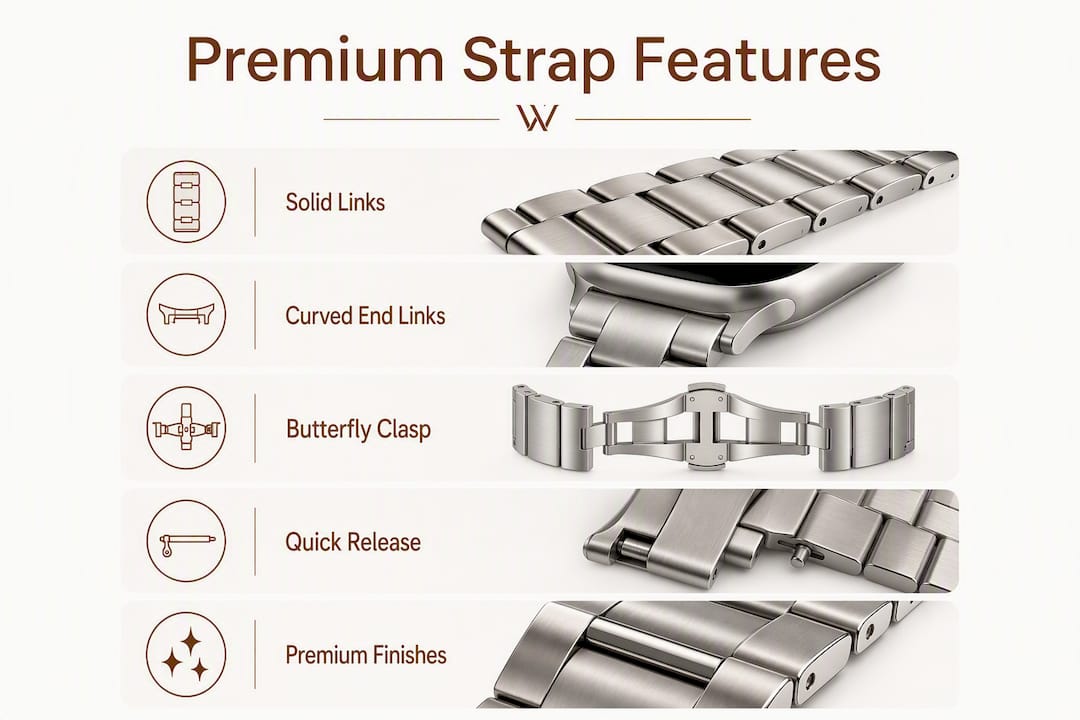
Clasp types define the security and the visual finish. A butterfly clasp (also called a jewelry clasp or deployant) folds flat and hides all hardware when closed. It distributes the opening force across two hinges, which reduces wear on the clasp spring over time. A standard pin buckle is functional but exposes hardware and adds bulk on the underside of the wrist.
Connectors and quick-adjust systems affect daily comfort. A quick-release connector lets you swap bands without tools. A micro-adjust system, whether half-links or a ratchet mechanism, lets you fine-tune the fit by small increments rather than jumping a full link at a time.
Finishes and surface treatments include polished, brushed, and PVD or ion-plated surfaces. PVD plating bonds a thin layer of color (gold, rose gold, black) to the base metal under high heat and vacuum. Thicker PVD coatings wear longer. Thin or uneven plating shows wear at high-contact points, typically the clasp edges and end links, within months.
Pro Tip: Ask the seller for a macro photo of the end link and the clasp spring bar. Those two details reveal more about construction quality than any lifestyle shot.
What materials are used in high-quality strap construction?
| Material | Key strength | Watch out for |
|---|---|---|
| 316L stainless steel | Marine-grade corrosion resistance; hypoallergenic for most skin types | Thin PVD plating wears at contact points |
| Ceramic | Scratch-resistant; jewelry-like sheen | More brittle than steel; heavier per link |
| Titanium | Lighter than steel; hypoallergenic | Usually pricier; matte finish only on most bands |
| PVD-plated steel | Visual color variety (gold, rose gold, black) | Plating thickness varies; check spec sheets |
| Leather (rembordé edge) | Comfortable; premium folded edge resists moisture | Requires dry storage; avoid soaking |
316L stainless steel is the baseline for premium metal bands. Its higher molybdenum content gives it marine-grade corrosion resistance, which is why it appears in surgical instruments and high-end watch bracelets alike. For daily Apple Watch wear, it handles sweat, soap, and light water exposure without pitting.
Ceramic links offer a scratch-resistant surface and a glassy sheen that reads as jewelry. The trade-off is brittleness. A ceramic link dropped on tile can crack where a steel link would not.
Leather bands with a rembordé edge wrap the top leather around the filler and tuck it under the lining, hiding the raw cut edge. That folded construction reduces moisture ingress and gives the strap a seamless profile. A cut edge finished with multiple coats of edge paint is the next tier down, still premium when done well, but more exposed to wear at the edge seam.
How does construction affect comfort and long-term value?
Solid-link construction changes how a band sits on the wrist. The weight is distributed evenly across each link rather than concentrated at the clasp, which reduces the tendency for the band to shift or rotate during wear. Tighter pin tolerances in solid links also produce quieter articulation. The band moves with the wrist rather than rattling against it.
Collectors have long used this logic with traditional watches. Swapping to a premium aftermarket band for daily wear keeps the original bracelet pristine and protects long-term resale value. The same principle applies to Apple Watch: a well-made metal band lets you wear the watch every day without adding wear to the original Sport Band or Milanese loop that came in the box.
A premium strap is also the most cost-effective way to change your Apple Watch’s character without buying a new watch. As one style guide puts it, it is the easiest luxury upgrade a watch owner can make.
How do you inspect a strap for premium quality?
Numbered checklist for online photos:
- Zoom into the end link. Look for a curved profile that matches the Apple Watch case contour.
- Check the link end grain. A solid link shows a clean, consistent cross-section. A folded link shows a seam or hollow.
- Examine the clasp closed. A butterfly or jewelry clasp should be flat with no visible hardware.
- Look at the connector. It should sit flush with no visible gap between the lug adapter and the case.
- Read the spec sheet. Confirm 316L stainless, the number of removable links, micro-adjust type, and warranty terms.
Red flags to avoid:
- Visible seam lines along link edges
- Thick, uneven plating with color variation across the surface
- Loose connectors with visible play in product video
- Missing material grade in the product description
- No returns or warranty information listed
Pro Tip: Request a macro photo of the clasp spring bar and the end link before ordering. Sellers who build to a real standard will send it without hesitation.
How do you size a premium metal Apple Watch band?
Step-by-step sizing:
- Wrap a soft tape measure or a strip of paper around your wrist just below the wrist bone.
- Note the measurement in millimeters. Most metal Apple Watch bands fit wrists in the 130–200 mm range.
- Check the band’s listed link count and whether half-links are included for micro-adjustment.
- Choose the correct lug adapter size. Apple Watch uses two connector groups: 38/40/41 mm cases and 42/44/45/49 mm cases. Confirm which group your series falls into before ordering.
Adjustment options:
- Removable links: Use a pin pusher or the included tool to push out the link pin. Remove one link at a time and test fit before removing more.
- Half-links: A half-link adds or removes roughly half a standard link length, useful when the band is one link too loose or too tight.
- Ratchet micro-adjust: Some clasps include a ratchet mechanism on the clasp itself, allowing fine adjustment without removing links.
Wizeband uses two size groups at checkout, covering Apple Watch Series 4–10, SE, and Ultra 2, so you select your case size and the correct connector ships with the band.
How do you care for a premium metal or ceramic band?
Daily maintenance is straightforward. Wipe the band with a soft, lint-free cloth after each wear. For a deeper clean, use mild soap and warm water with a soft-bristle brush, then rinse and dry completely before storing.
Key care rules:
- Avoid chlorine pools and harsh chemical cleaners. Both accelerate PVD plating wear.
- Rotate bands if you own more than one. Less daily contact time extends plating life on each.
- Store metal bands flat or coiled loosely in a soft pouch to prevent pin stress and surface scratches.
- For leather bands with a rembordé edge, keep them dry. Wipe moisture off immediately and allow air drying away from direct heat.
“Edge finishing is both aesthetic and functional — multiple paint-and-dry cycles on a strap’s edges prevent water ingress and extend the strap’s usable life.” — LIC Factory walkthrough, WatchGecko
Do not use ultrasonic cleaners on PVD-plated or glued construction. The vibration can lift plating at seams and loosen adhesive bonds between layers. If a defect appears within the warranty period, photograph it and contact the seller before attempting any repair.
How Wizeband meets the premium construction standard
Wizeband builds its Apple Watch bands around the same checklist this article describes.
- Material: 316L stainless steel throughout, with ceramic options in select styles
- Links: Solid metal links in classic, quadruple-chain, and premium link configurations
- Clasps: Butterfly and jewelry clasps standard across the lineup
- Finishes: Silver Gold, Starlight, Rose Gold, and Gold in PVD-treated surfaces
- Compatibility: Apple Watch Series 4–10, SE, and Ultra 2, in two connector size groups
- Adjustability: Quick-adjust systems and removable links on all metal bands
| Construction feature | Wizeband standard |
|---|---|
| Base metal | 316L stainless steel |
| Link type | Solid metal links |
| Clasp | Butterfly / jewelry clasp |
| Finish options | Silver Gold, Starlight, Rose Gold, Gold |
| Apple Watch compatibility | Series 4–10, SE, Ultra 2 |
| Sizing system | Two size groups, removable links, quick-adjust |
Wizeband’s premium metal straps sit under $100, which reflects a direct-to-consumer model that cuts retail markup. Raw materials and labor are a modest portion of a strap’s retail price; the rest covers quality assurance, design, and service. At Wizeband’s price point, buyers get construction quality that would cost more through traditional retail channels.
Key Takeaways
Premium strap construction combines solid links, flush end links, a jewelry-style clasp, 316L stainless steel, and a precise connector fit to deliver a band that wears like jewelry and holds up daily.
| Point | Details |
|---|---|
| Solid links are the baseline | Solid machined links feel heavier, move quietly, and show a clean cross-section at the end grain. |
| End link fit defines the look | Curved end links sit flush against the Apple Watch case; flat generic ends leave a visible gap. |
| Clasp type signals quality | A butterfly or jewelry clasp hides all hardware when closed and distributes wear across two hinges. |
| 316L stainless is the standard | Marine-grade corrosion resistance makes 316L the trusted base metal for premium Apple Watch bands. |
| Wizeband delivers the checklist | Solid links, butterfly clasps, 316L stainless, and quick-adjust sizing across Series 4–10, SE, and Ultra 2. |
Why construction details are worth your attention
Most buyers focus on color and price. Construction is what determines whether a band still looks good in two years or starts showing wear at the clasp edges after six months. The difference between a folded link and a solid one is not visible in a lifestyle photo, but it shows up in how the band feels on the wrist and how it holds its finish over time. A jewelry-style clasp is not just a visual choice. It distributes stress differently than a pin buckle, which means the closure mechanism lasts longer under daily use. These are not marketing claims. They are the result of how the parts are made and how they interact. Buyers who understand construction signals can make better decisions from a product page, without needing to handle the band in person first.
Wizeband bands that meet this standard
Wizeband offers metal and ceramic Apple Watch bands built to the construction checklist above, at a price point that does not require a luxury-brand budget.
The Gaia Metal Strap is a strong starting point for jewelry-like link construction in Rose Gold or Silver Gold. The Wizeband Essentials Bundle gives you multiple finishes at once, useful if you want to match different outfits without buying individual bands separately. For a first purchase, the Wizeband Starter Kit covers the basics with the same 316L stainless construction and butterfly clasp standard. Visit Wizeband’s store to check compatibility with your Apple Watch model and select your size group at checkout.
Useful sources
- Strapcode: 7 Best Watch Band Materials — Material-by-material breakdown of stainless steel grades, leather types, and rubber categories. Best for comparing 316L vs. 304 vs. 904L and understanding why grade matters.
- WatchGecko: LIC Factory Walkthrough — Step-by-step production and QC process for premium straps. Best for understanding hand-finishing, edge painting, and structural prep steps.
- LBS London: What Makes a Leather Strap Premium? — Detailed explanation of rembordé vs. cut-edge construction and how each affects moisture resistance and durability.
- iLounge: The Easiest Luxury Upgrade — Style-focused framing of why a strap upgrade changes a watch’s character without replacing the watch.
- Impact Wealth: Why Collectors Switch to Premium Straps — Collector perspective on using aftermarket bands for daily wear to preserve original components and resale value.
Recommended
From the blog
View all


Leave a comment