


Does Your Apple Watch Band Snag Clothes? A Clear Guide
Metal-mesh Apple Watch bands — including Milanese-style loops — can snag clothing, with frequency and severity depending on fabric type, band finish quality, and how snugly the band fits your wrist. Cashmere, silk, and loose-knit wool are the highest-risk fabrics; a lower-quality third-party mesh band with unfinished edges is the most common culprit; and a loose fit that lets the band shift around multiplies contact points. Apple Watch forum threads document real fabric damage — torn cashmere, frayed sweater hems, pulled silk threads — and those reports skew heavily toward lower-cost third-party bands rather than genuine Apple hardware.
- Fabric risk: cashmere, silk, fine-knit wool (high); terry, boucle (medium); denim, tightly woven cotton (low)
- Band quality: OEM-style finished links snag less; cheap third-party mesh with thin, unpolished wire snags more
- Fit: a snug, stable band reduces movement and lowers the chance of hardware catching threads
If you’re worried right now, check your band for visible burrs and tighten the fit one notch. If you’re wearing cashmere or silk today, swap to a silicone or leather band.
Key Takeaways
Metal-mesh Apple Watch bands snag clothing most often when the band has unfinished edges, the fit is loose, or the garment is a high-risk fabric like cashmere or silk.
| Point | Details |
|---|---|
| Fabric risk is the first filter | Cashmere, silk, and loose-knit wool are high-risk; dense denim and tightly woven cotton are low-risk. |
| Band quality drives most incidents | Third-party mesh with thin, unpolished wire causes far more damage than OEM-style finished bands. |
| Fit controls movement | A snug band per Apple’s guidance reduces shifting and lowers contact with sleeve fabric. |
| Maintenance prevents buildup | Clean the mesh and magnet housing regularly to remove metal filings that abrade fabric over time. |
| Wizeband’s approach | 316L stainless steel with finished links and a quick-adjust clasp addresses the main quality gaps that cause snagging. |
Table of Contents
- Why does an Apple Watch band snag clothes?
- Which fabrics are most likely to snag?
- What do real users actually report?
- How does band quality change your snag risk?
- How fit and wearing habits affect snagging
- What to do if your metal band is already snagging
- An honest take on metal bands and delicate clothing
- Wizeband metal bands are built to reduce snag risk
- Sources
Why does an Apple Watch band snag clothes?
The mechanics are straightforward. A metal-mesh band is a woven grid of small wire links, and every intersection point is a potential snag site. Loose fibers from knit garments can slip into those gaps and catch on link edges before the fabric pulls away. The finer the mesh weave and the sharper the link edges, the more aggressive that interaction becomes.
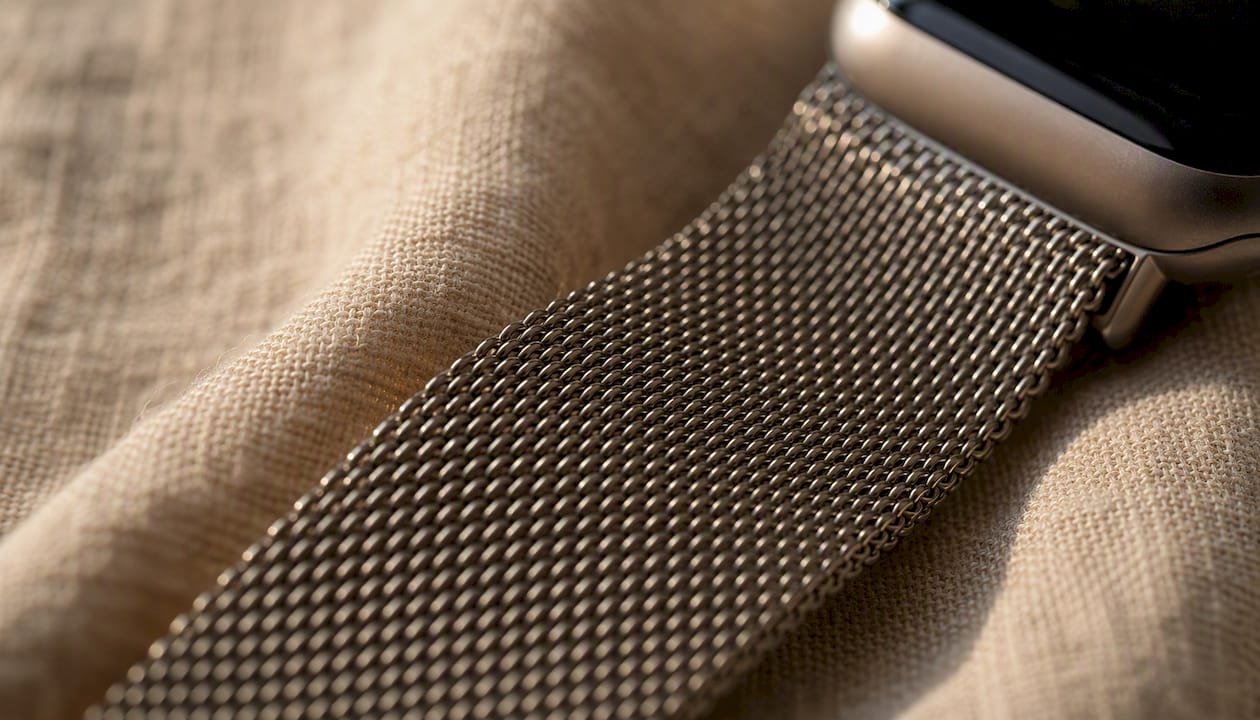
Everyday wear makes things worse over time. Friction against cuffs and sleeve hems gradually wears down any protective coating and can create microscopic burrs on link edges. Trapped debris — metal filings shed during normal wear, lint, and dust — collects inside the mesh and adds abrasive particles that grind against fabric. Cleaning the magnetic housing and removing metallic debris from the mesh is one of the most overlooked maintenance steps, yet it directly reduces both fabric abrasion and clasp wear.
Manufacturing choices change the baseline risk significantly. Bands with tumble-polished or CNC-finished links have rounded edges that glide past fibers rather than catching them. Bands with thinner wire and no post-production finishing leave sharp intersections exposed. Understanding luxury watch band finishing terms like chamfering and tumble-polishing helps you spot which category a band falls into before you buy.
Pro Tip: Run your fingernail slowly along the underside of the mesh and around the magnet housing seam. Any snag or scratch on your nail signals a rough edge that will catch fabric. Do this on arrival, before the first wear.
Which fabrics are most likely to snag?
Not all garments face equal risk. The structure of the fabric matters as much as the fiber content.
High-risk fabrics:
- Cashmere and fine-knit wool — loose loops catch on link edges easily
- Silk — smooth but fragile; a single sharp edge can pull a thread
- Loosely woven knits and open-stitch sweaters — large gaps between yarns invite link edges in
- Delicate synthetic blends (modal, rayon jersey) — low-twist yarns break under minimal friction
Medium-risk fabrics:
- Terry cloth and toweling — loops can fray with repeated contact
- Boucle and textured weaves — irregular surface creates more contact points
Low-risk fabrics:
- Dense denim and canvas — tightly packed yarns resist snagging
- Tightly woven cotton (poplin, broadcloth) — smooth surface, minimal snag opportunity
- Leather and faux leather — no fiber loops to catch
Before wearing a metal-mesh band with a new garment, test it on an inconspicuous seam or interior hem. Press the band lightly against the fabric and drag it a short distance. If you see any fiber lift or hear a faint catch, treat that garment as high-risk. Check cuffs and hemlines specifically — those are the contact zones where watch band fabric damage shows up first.
What do real users actually report?
Forum evidence is consistent and worth taking seriously. The dominant pattern across Apple Discussions and MacRumors threads: third-party mesh bands tend to cause more reported damage than OEM-style bands, which can also cause some damage, usually at cuffs and sweater hems.
MacRumors users note that genuine Apple Milanese loops use thicker, more rounded links and snag less than many third-party clones with thinner, sharper weaves. That gap in finishing quality is the single most consistent finding across community threads.
Forum pattern: Reports of fabric damage from third-party mesh bands appear far more frequently than reports involving genuine Apple hardware, with users describing visible burrs and unfinished link ends on cheaper bands straight out of the box.
Clasp and QC issues add another layer of risk. When a clasp doesn’t close fully, the band shifts more on the wrist, increasing contact with sleeve fabric. Users who notice an apple watch clasp keeps opening should treat that as a snag-risk signal, not just a comfort issue.
How does band quality change your snag risk?
Material and finishing are the two variables you can actually control at purchase. Here’s what to look for.
316L stainless steel is the baseline standard for quality metal bands. It holds a polish well, resists corrosion, and doesn’t shed metal filings the way lower-grade alloys or plated steel can. Plated bands wear through their surface coating over months, exposing rougher base metal underneath — that’s when abrasion against fabric accelerates.
Finishing cues to check:
- Link roundness: links should feel smooth under a fingernail, not angular
- Magnet housing seam: run a finger around the edge; no sharp lip should be detectable
- Clasp fit: the clasp should close with a clean click and stay closed under light tension
- Overall weight: heavier bands generally indicate thicker wire and more material, which correlates with better finishing
- Color coating: anodized or PVD finishes outlast simple electroplating and maintain a smoother surface longer
Pro Tip: At point of sale or on arrival, hold the band under a strong light at a low angle. Rough link edges scatter light unevenly and show up as dull patches or micro-glints against a polished surface. A uniformly reflective mesh is a good sign.
Watch-industry guidance confirms that premium finishing reduces abrasive interactions with clothing — tumble-polishing rounds out link intersections that would otherwise act like tiny hooks. Minor rough spots on an otherwise good band can sometimes be smoothed with a jeweler’s file, but only on an external edge and only if you’re confident about what you’re touching. When in doubt, return the band.
Wizeband builds its metal bands from 316L stainless steel with finished links and secure butterfly clasps, which addresses the main quality gaps that forum reports consistently flag in cheaper alternatives.
How fit and wearing habits affect snagging
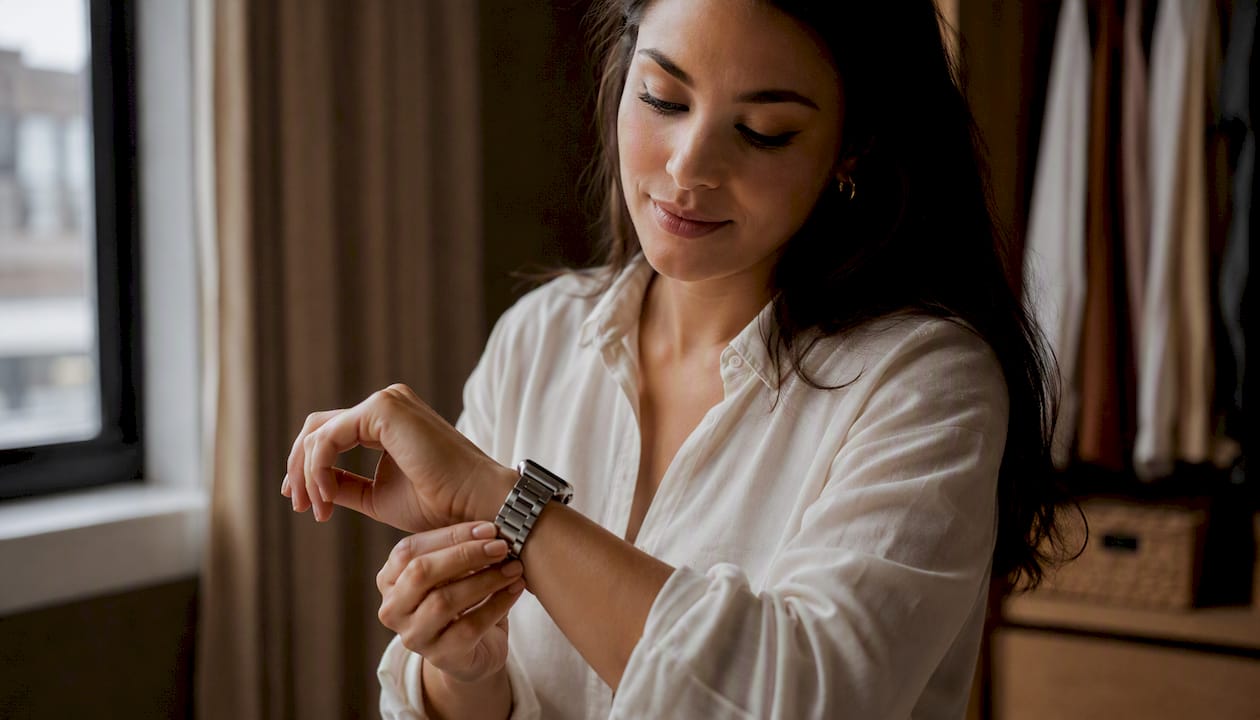
Fit is the easiest variable to fix today. Apple’s guidance recommends wearing the watch snugly enough for sensors to maintain contact with the skin. A loose band doesn’t just affect heart-rate accuracy — it lets the watch shift up and down the wrist, dragging the band edge across sleeve fabric with every arm movement.
Practical band fit adjustments that reduce snag risk:
- Tighten the band so it sits stable but not constricting — you should be able to slide one finger underneath
- Tuck sleeve cuffs over the band rather than letting them bunch at the wrist edge
- Avoid sliding a tight cuff past the band; remove the watch or roll the sleeve first
- Remove the band entirely when pulling on chunky knitwear or cashmere
Pro Tip: After adjusting fit, check sensor contact by opening the Heart Rate app and confirming a reading within 10 seconds. If it reads immediately, the fit is snug enough. If it takes longer or fails, tighten one notch.
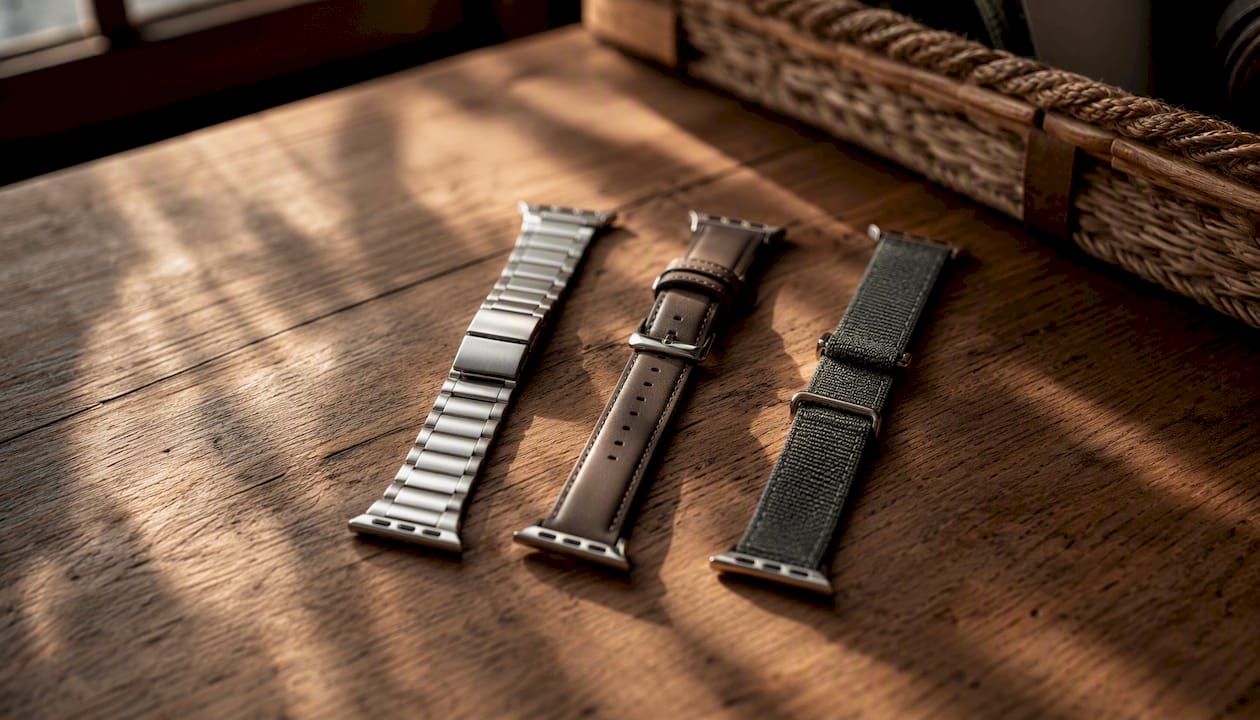
Strap rotation is the most practical long-term habit. Keep a metal band for office wear and everyday outfits; switch to a silicone or leather band for work when wearing delicate fabrics. A 3-slot watch roll makes storing and rotating bands easy without tangling or scratching them.
What to do if your metal band is already snagging
Work through these steps in order before deciding whether to repair or replace.
- Stop wearing the band with delicate fabrics immediately. Continued use risks more damage to garments you can’t repair.
- Inspect the band under strong light. Look for visible burrs, bent link ends, or a rough magnet housing seam.
- Clean the mesh and magnet housing. Use a soft toothbrush and warm water to remove trapped metal filings and lint. Dry thoroughly. This alone sometimes resolves mild abrasion.
- Test the clasp. Close it firmly and tug the band. If the clasp opens under light pressure, the band needs repair or replacement — a loose clasp increases movement and snag risk.
- Smooth an obvious sharp spot cautiously. A jeweler’s file on an external link edge is safe if the rough point is clearly visible and isolated. Do not file inside the mesh weave.
- Test on a low-risk fabric first. Before returning to normal wear, drag the band across a piece of dense cotton. No fiber lift means the fix worked.
If the band fails step 2 or step 4, the right call is a return or replacement. Gather photos of the fabric damage and close-up shots of the band’s rough edge — that documentation supports a warranty or return claim. A watch strap guide notes that metal bracelets are versatile for everyday wear but mesh or fine finishes warrant caution around delicate fabrics, which supports switching to leather or FKM rubber when the garment risk is high.
An honest take on metal bands and delicate clothing
Metal-mesh bands are genuinely stylish, and the snagging problem is often overstated — but only for well-made bands worn at the right fit. The forum evidence points towards lower-cost third-party mesh bands as the primary offenders, not the category as a whole. A quality-finished band worn snugly causes far fewer incidents than the loudest forum posts suggest.
What gets underestimated is the cumulative effect of small habits. Most fabric damage doesn’t happen in one dramatic snag. It builds up over weeks of sleeve friction, loose fit, and an uncleaned magnet housing. The readers who never have a problem are usually the ones who rotate bands, keep the mesh clean, and don’t force a tight cuff past the watch face.
The practical stance: own at least two bands. Use a metal band for everyday and office wear. Switch to silicone or leather when the outfit calls for it. Inspect the metal band every few months for burrs. That routine eliminates most of the risk without giving up the look.
Wizeband metal bands are built to reduce snag risk
The gap between a band that snags and one that doesn’t usually comes down to finishing quality and fit precision — exactly where cheap third-party mesh falls short. Wizeband’s metal bands are made from 316L stainless steel with finished, rounded links and secure butterfly clasps that stay closed under normal wear. The quick-adjust system lets you dial in a snug, stable fit without tools, which keeps the band from shifting against sleeve fabric throughout the day.
For readers who want a metal band that looks polished and behaves well around everyday fabrics, the Wizeband Essentials Bundle pairs a finished metal band with an alternative strap so you have a rotation option ready from day one. If you prefer to start with a single metal style, the Gaia Metal Strap is a good starting point. Both options are compatible with Apple Watch Series 4–10, SE, and Ultra 2. Browse the full lineup at Wizeband and check the return window before ordering.
Sources
- Milanese loop band tearing up my expensive clothes
- Apple Support — Apple Watch user guide
- Watch Strap Materials Guide: Rubber, Leather & More | Helvetus®
- What’s the Milanese Loop like? | MacRumors Forums
- Watch strap guide — leather vs NATO vs rubber vs metal (TheWatchology)
Recommended
From the blog
View all


Leave a comment