


Metal Link Watch Band Care Tips for Apple Watch Owners
Wipe your band with a dry microfiber cloth after every wear, clean it with warm soapy water weekly or monthly, and inspect pins and clasps monthly. That three-step routine covers most of what keeps a metal link band looking sharp and lasting for years. Perspiration carries chlorides that attack the passive oxide layer on stainless steel, so the wipe-down after each wear is the single most important habit you can build. Seiko’s care guidance confirms that trapped perspiration in link gaps is the primary driver of pitting and crevice corrosion.
- Daily: dry microfiber wipe immediately after removing the watch
- Weekly or monthly: warm water, mild soap, soft brush, thorough rinse and dry
- Quarterly: deep clean, full pin and clasp inspection
- After salt water or pool exposure: rinse with fresh water right away
Pro Tip: If your band was exposed to salt water or sunscreen, rinse it under fresh water within an hour. Don’t wait until your next regular clean.
Key Takeaways
A daily wipe-down after wear is the single most effective habit for preserving a metal link band’s finish and preventing pitting corrosion.
| Point | Details |
|---|---|
| Daily wipe is non-negotiable | Wipe with a dry microfiber cloth after every wear to remove chloride-carrying sweat. |
| Fit affects corrosion risk | Keep a one-finger gap between band and wrist to allow airflow and reduce trapped moisture. |
| Three cleaning depths | Light (daily wipe), regular (weekly or monthly warm soapy water), deep (quarterly pin and clasp inspection). |
| Two red flags | Visible pitting or a loose pin means stop wearing immediately and seek repair. |
| Wizeband 316L bands | Wizeband’s machined 316L steel bands with quick-adjust clasps are designed to minimize moisture traps and simplify daily care. |
Table of Contents
- What are the best metal link watch band care tips for daily wear?
- Why do “stainless” metal link bands still corrode?
- How to clean metal link bands: three levels of care
- How does fit affect how long your band lasts?
- What exposures actually damage metal bands, and what should you do?
- Should you polish scratches on a metal link band?
- How to inspect and maintain link pins and clasps
- How should you store a metal link band?
- Nickel release and skin sensitivity: what you need to know
- Quick fixes for common metal band problems
- A note on caring for premium metal Apple Watch bands
- Wizeband metal bands are built for daily wear and easy care
- Editorial perspective on metal link band care
- Sources
What are the best metal link watch band care tips for daily wear?
A 30-second routine after every wear prevents most damage:
- Wipe the entire band with a soft, dry microfiber cloth, paying attention to the undersides of links where sweat pools.
- Shake the band gently or run a soft-bristled brush through link gaps to dislodge debris.
- Check that the clasp closes cleanly and that no grit is caught in the butterfly mechanism.
- Loosen the band slightly if it felt tight during the day. Garmin’s wear and care guidance recommends about a one-finger gap between band and wrist to allow airflow and reduce moisture buildup.
Pro Tip: Keep a microfiber cloth on your nightstand or next to the bathroom sink. Placing it where you take the watch off removes the friction of having to find it.
Why do “stainless” metal link bands still corrode?
The word “stainless” means stain-resistant, not stain-proof. 316L stainless steel, the most common alloy in watch bands, gets its corrosion resistance from a thin chromium oxide layer that forms on the surface. Chlorides in sweat and salt water can break through that layer, especially in the tight crevices between links where moisture sits for hours.
Common alloys you’ll encounter:
- 316L (marine grade): lowest carbon content, best corrosion resistance for everyday wear
- 904L: higher nickel and chromium content, used in premium watches, slightly better chloride resistance
- 304L: less corrosion-resistant than 316L; less common in quality bands
Manufacturing method also matters. Research on watch strap steels shows that different grades and production processes produce widely different corrosion performance. Metal-injection-molded (MIM) links, which are common in lower-cost bands, can show greater variability in corrosion resistance than machined or wrought links.
Nickel release warning: Some metal-injection-molded (MIM) links can have higher variability in nickel release, which may affect sensitive skin. If you have sensitive skin or a known nickel sensitivity, the alloy and manufacturing process of your band matter more than the grade name alone.
How to clean metal link bands: three levels of care
Light clean (after workouts or sweaty days)
Wipe the band with a damp microfiber cloth immediately after heavy perspiration. Citizen’s care guidance recommends wiping off heavy perspiration right away and using a neutral detergent with a soft toothbrush for heavier soiling. If the watch head is not water-resistant, protect it with plastic wrap before any wet cleaning.
Regular clean (weekly or monthly)
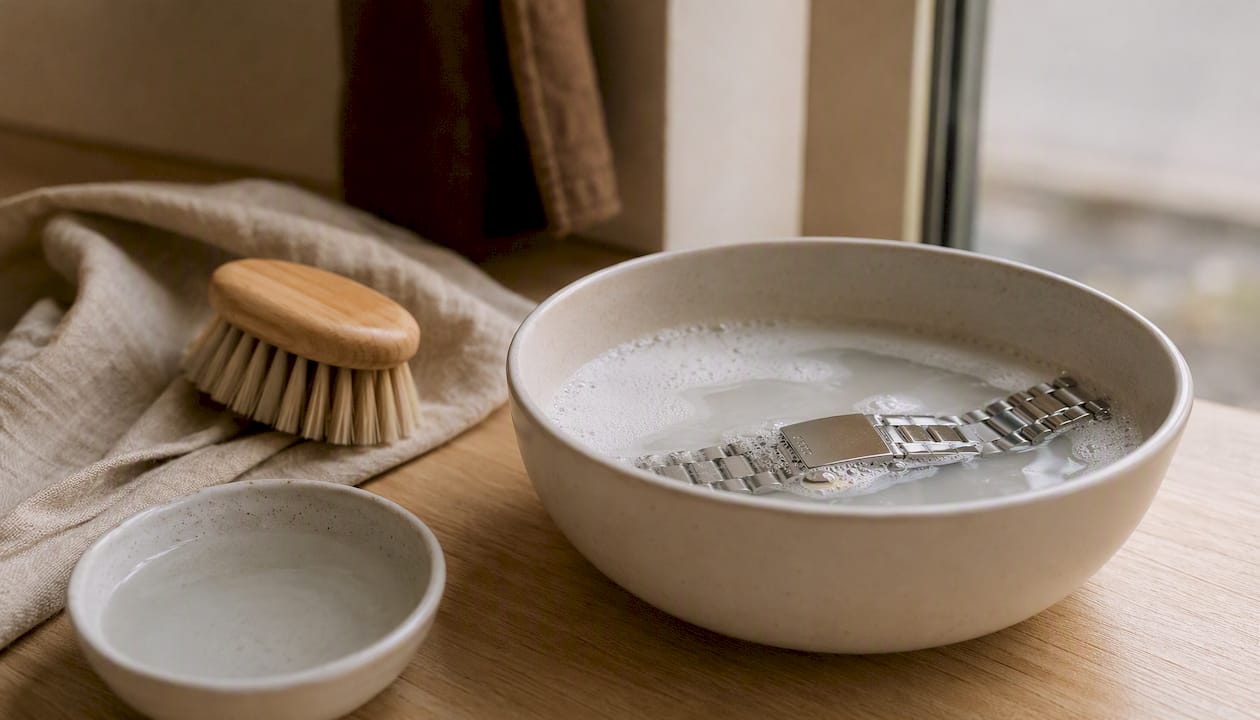
- Fill a small bowl with lukewarm water and a few drops of mild dish soap.
- Remove the band from the watch if the lugs allow it, or wrap the watch head in plastic wrap.
- Dip a soft-bristled toothbrush or interdental brush into the soapy water.
- Scrub link gaps, pin holes, and the clasp mechanism gently.
- Rinse under cool running water until all soap is gone.
- Pat dry with a microfiber cloth, then leave flat on a dry surface for 15 minutes before wearing.
The Watch Company’s cleaning guide recommends monthly cleaning for daily-worn bands as a minimum.
Deep clean (quarterly or after heavy exposure)
- Remove the band fully from the watch.
- Use an ultrasonic cleaner only if the manufacturer permits it and pins are secure.
- Use a wooden toothpick or skewer to clear debris from pin holes; avoid metal tools that scratch.
- Avoid solvents, bleach, or abrasive cleaners. These strip protective coatings and can pit bare steel.
Tools you need: soft-bristled toothbrush or interdental brush, microfiber cloth, small bowl, mild soap, wooden toothpick.
Pro Tip: Never use metal polish on a PVD- or DLC-coated band. Those coatings are thin, and polish removes them permanently.
How does fit affect how long your band lasts?
A band worn too tight traps moisture against the skin and inside link gaps. That trapped sweat, sitting for hours, is exactly the chloride exposure that drives pitting. The one-finger gap rule from Garmin’s wear guidelines is a practical standard: you should be able to slide one finger under the band without forcing it.
Habits that shorten band life:
- Sleeping with a tight band, which keeps moisture against the steel all night
- Wearing the band during heavy workouts without wiping it down afterward
- Leaving the band on during prolonged water exposure (pools, ocean) without rinsing after
- Never rotating to a second band, which gives the metal no recovery time
Rotating between two bands, even occasionally, extends the life of both. After any heavy sweat session or water exposure, take the band off for at least 30 minutes to let it dry fully.
What exposures actually damage metal bands, and what should you do?
Salt water and pool chemicals are the two most aggressive threats. Chlorinated pool water and ocean salt both accelerate pitting and crevice corrosion, particularly in the tight gaps between links. Sunscreen, perfume, and hand lotion leave residues that trap moisture and can react with metal surfaces over time.
Immediate steps after exposure:
- Rinse the band under fresh, cool water as soon as possible.
- Towel dry, then use a microfiber cloth to wipe into link gaps.
- For sunscreen or lotion residue, follow with a mild soap wash and full rinse.
For more detail on water-specific care, Wizeband’s Apple Watch metal band water exposure guide covers depth ratings and what to do after different types of water contact.
Pro Tip: Remove the band before applying perfume or sunscreen. Both products are designed to stay on skin, and they will stay on your band too.
Do not use metal polish after chemical exposure. The surface may already be compromised, and polish compounds can work abrasives into micro-pits and worsen them.
Should you polish scratches on a metal link band?
Light surface scratches on bare 316L stainless steel can be buffed out by a professional jeweler or watchmaker using a fine polishing cloth. For uncoated brushed-finish bands, a jeweler’s polishing cloth applied in the direction of the grain can reduce the appearance of minor marks.
- PVD-coated bands: Do not polish. The coating is typically just a few microns thick. Abrasive compounds remove it and expose bare steel underneath, reducing corrosion resistance.
- DLC-coated bands: Same rule. DLC (diamond-like carbon) is harder than PVD but still thin. Once gone, it cannot be restored at home.
- Deep gouges or coating failure: These need professional refinishing or band replacement. A watchmaker or the band manufacturer can advise on whether refinishing is possible.
Pro Tip: Accept light patina on a daily-worn band. Trying to polish out every small mark on a coated band does more damage than the scratches themselves.
How to inspect and maintain link pins and clasps
Link pins and the clasp are the two points most likely to fail if corrosion goes unchecked. Seiko’s maintenance guidance notes that pins are primary hotspots for sweat and grime and that corroded or loose pins can cause the watch to fall off.
Monthly inspection steps:
- Hold the band up to light and flex each link section. Any link that moves more than its neighbors has a loose or corroded pin.
- Look into pin holes for discoloration or white residue, both signs of corrosion.
- Open and close the clasp several times. It should click firmly with no lateral play.
- Check end-links where the band meets the watch lugs; these see the most stress.
For link removal or resizing, Wizeband’s guide on how to adjust a metal watch strap walks through safe steps. A band link removal tool handles most standard pins without risk of scratching. For bent pins or visible pitting inside pin holes, take the band to a jeweler rather than forcing the pin out yourself.
Preventing crevice corrosion at pins:
- Clean pin holes with a wooden toothpick after each deep clean.
- Dry the band fully before storing or wearing.
- Avoid mixing dissimilar metals in the assembly (e.g., a steel band with a brass adapter), as galvanic corrosion can accelerate at the contact point.
How should you store a metal link band?
Short-term storage (overnight or a few days): lay the band flat or coiled in a soft pouch, away from other jewelry that could scratch it.
Long-term storage tips, per Wizeband’s storage guidance:
- Store dry. Any residual moisture accelerates corrosion during storage.
- Use a soft microfiber pouch or a watch roll with individual slots.
- Place a silica gel packet in the storage container if you live in a humid climate or near the coast.
- Avoid leaving bands in a hot car or a damp bathroom. Heat and humidity together accelerate oxidation.
- Check stored bands every few months for discoloration or stiffness in the links.
Pro Tip: A small zip-lock bag with one silica gel packet is a practical, low-cost solution for storing a band you won’t wear for several weeks.
Nickel release and skin sensitivity: what you need to know
Nickel is present in most stainless steel alloys, including 316L. Under normal conditions, the chromium oxide layer limits how much nickel migrates to the skin. The European REACH regulation sets a benchmark of 0.5 µg/cm²/week for nickel release from items in prolonged skin contact.
Lab tests on MIM 316L and 904L samples found nickel release values ranging from 2 mg·cm⁻²·week⁻¹ to 24 mg·cm⁻²·week⁻¹ in some samples, far above the REACH limit. MIM manufacturing, which is common in cost-optimized bands, showed greater variability than conventional wrought or machined steel.
| Parameter | Value |
|---|---|
| REACH nickel release limit | 0.5 µg/cm²/week |
| MIM sample range (lab study) | 2–24 mg·cm⁻²·week⁻¹ |
Practical steps for sensitive wearers:
- Choose bands made from well-specified 316L with conventional machining, or bands with PVD/DLC coatings that create a barrier between steel and skin.
- Wizeband’s hypoallergenic metal watch band options and bands for sensitive skin cover material and finish choices for reactive wearers.
- If a rash, redness, or persistent irritation develops under the band, stop wearing it and consult a dermatologist.
Quick fixes for common metal band problems
- Stiff links: Soak in warm soapy water for five minutes, scrub with an interdental brush, rinse, and dry. Stiffness usually comes from dried sweat residue in pin holes.
- Stuck clasp: Apply one small drop of watch oil to the clasp mechanism with a toothpick. Open and close several times. Do not use WD-40 or general lubricants; they attract grit.
- Yellow or brown cuff staining on skin: This is usually a reaction between sweat, lotion residue, and the band surface. Clean the band thoroughly and let it dry for 24 hours before wearing again.
- Loose pin: Stop wearing the band. A loose pin can pull free and drop the watch. Take it to a jeweler or contact the band manufacturer for a replacement pin.
- Visible pitting or white corrosion deposits: Stop wearing. Surface pitting means the passive layer is compromised. Professional assessment is needed before the band is safe to wear again.
Pro Tip: Inspect pins every time you deep clean. Catching a loose pin early costs nothing. Losing a watch because a pin failed costs considerably more.
A note on caring for premium metal Apple Watch bands
Metal link bands built from 316L stainless steel with machined links and quality clasps are designed to last for years with basic care. Wizeband’s bands use 316L steel, quick-adjust systems, and butterfly clasps, all of which are designed to minimize trapped moisture points and make daily cleaning straightforward. The quick-adjust mechanism means you can loosen the band slightly after a workout without removing it, which helps with airflow.
For storage, Wizeband’s published guidance recommends dry storage in a soft pouch with silica gel for humid environments. If you need replacement links or have a clasp issue, Wizeband’s support team can advise on compatible parts.
Wizeband metal bands are built for daily wear and easy care
Wizeband’s 316L stainless steel bands are a practical choice for Apple Watch owners who want a band that holds up to daily life without constant maintenance. The Tokyo Metal Strap and Gaia Metal Strap are both built from 316L steel with quick-adjust sizing, so you get the right fit without tools. If you want to start with a set, the Wizeband Essentials Bundle includes multiple band styles compatible with Apple Watch Series 4–10, SE, and Ultra 2.

All Wizeband bands come with sizing support, and the team can help with link adjustments or replacement parts. Browse the full range at Wizeband and find the band that fits your style and your routine.
Editorial perspective on metal link band care
Most care guides treat metal watch bands as an afterthought. The real issue is that people assume “stainless” means maintenance-free, then wonder why their band looks dull or develops a rash-causing residue after six months.
The evidence is clear: manufacturing quality matters as much as the alloy grade. A band labeled 316L made with MIM links can perform worse in corrosion tests than a well-machined 304L band. That gap is not visible at purchase. The practical response is to buy from brands that specify their manufacturing process, keep the band clean, and inspect pins regularly. Wizeband’s use of machined 316L links with butterfly clasps addresses the two main failure points: crevice corrosion at pins and clasp mechanism wear.
The one habit most people skip is the post-wear wipe. It takes ten seconds and prevents most of the pitting that makes bands look old before their time. Everything else in this guide builds on that one step.
Sources
These are the primary sources used for factual claims in this guide:
- How should I care for my watch band? | Seiko Watch Corporation
- Garmin | Wear and Care Tips
- Watch stainless steel grades explained — Time+Tide
- Corrosion resistance of watch strap steels (MDPI)
- How to Clean Metal Watch Bands: A Detailed Guide - The Watch Company
Bottom line: The research and manufacturer guidance all point to the same core routine: wipe after wear, clean regularly, inspect pins, and never use abrasive polish on a coated band. Those four habits cover the vast majority of metal link band care.
Recommended
From the blog
View all


Leave a comment