


Steel Grade and Apple Watch Band Longevity Guide
316L stainless steel is a widely regarded choice for premium Apple Watch bands. It offers strong corrosion resistance, tends to release low levels of nickel ions, and generally maintains mirror and brushed finishes better than some other grades. Wizeband builds its full metal lineup from 316L for exactly these reasons. 904L exists and is technically superior, but its processing cost is significantly higher with little practical benefit for everyday Apple Watch wear. Plated base metals are the grade to avoid: they look fine at first, then chip, corrode, and irritate skin within months.
Table of Contents
- How does steel grade affect band longevity?
- Which steel grade is best for Apple Watch bands?
- Does construction quality matter as much as steel grade?
- How does steel grade affect skin sensitivity?
- How long does a 316L Apple Watch band last?
- What to check on a product page before you buy
- Key Takeaways
- The grade is only half the story
- Wizeband’s 316L metal bands: ready to wear
- Useful sources
How does steel grade affect band longevity?
Steel grade determines four things that matter directly to how a band looks and feels after months of daily wear.
- Corrosion resistance — 316L contains molybdenum, which integrates into the passive chromium oxide layer and helps block chloride-induced pitting. 304 stainless steel contains no molybdenum and commonly performs worse in salt-spray testing compared to 316L.
Together, these four mechanisms explain why a durable everyday watch band made from 316L outlasts one made from 304 or plated metal by years, not months.
Which steel grade is best for Apple Watch bands?
316L is the practical choice for Apple Watch bands. 904L is technically better on corrosion resistance and polish depth, but its processing costs and supply-chain complexity make it a niche, luxury-level choice rather than a meaningful upgrade for everyday wear.
| Dimension | 316L | 904L | 304 / Plated |
|---|---|---|---|
| Corrosion resistance | — | Exceeds 316L | — |
| Nickel migration | Low; stable passive layer | Very low | Higher; plating wears through |
| Finish retention | Holds mirror and brushed finishes long-term | Slightly deeper polish | Prone to pitting and staining within months |
| Price / processing | Mid-range; widely available | Significantly higher cost | Cheapest upfront; highest replacement cost |
Industry specialists note that labels like “surgical grade” and “marine grade” reflect real performance credentials in medical and maritime environments. For Apple Watch bands, those credentials translate directly to reliable skin contact and moisture exposure.
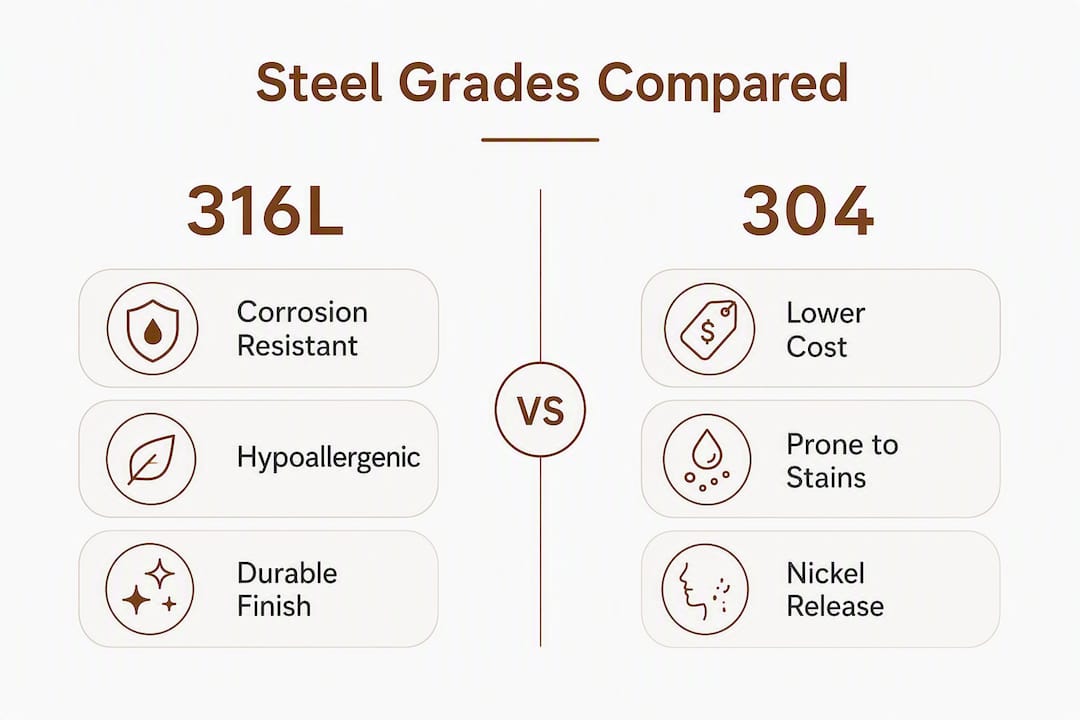
304 is generally less expensive in raw material cost, but it tends to develop staining, pitting, and nickel-release issues in coastal, humid, or heavy-sweat conditions within months to a year of daily wear. Plated metals are worse: the base metal corrodes once the coating chips. 904L makes sense for a luxury-positioned product where the price premium is part of the appeal. For most buyers, 316L covers every real-world need.
Does construction quality matter as much as steel grade?
Yes. A well-made 316L band with solid links and a high-quality finish will out-perform a poorly made band of a higher grade. The alloy name on a spec sheet means nothing if the links are hollow, the clasp is plated zinc, or the finish is inconsistent across small components.
Watchmakers confirm that finish quality and machining precision matter more for long-term appearance than the alloy name alone. A well-finished 316L band holds texture where a poorly finished higher-grade band will not. Here is what to check before buying:
- Solid vs. hollow links. Solid links resist denting and maintain shape under daily pressure. Hollow links flex, creak, and dent.
- Full-metal hardware. The clasp, end links, and adjustment pins should all be 316L or at minimum stated as stainless. A plated clasp on a 316L band is the first part to fail.
- Finish consistency. Mirror polish and brushed satin should look uniform across every link, including the small connector pieces. Inconsistent finish signals lower machining tolerances.
- Weld quality at joints. Visible gaps or rough seams at link joints indicate carbide precipitation risk, the exact problem the “L” specification prevents.
Pro Tip: Look for close-up product photos that show the clasp and end links clearly. If a listing only shows the band face-on with no clasp detail, ask the seller directly: “Is the clasp solid 316L or plated?” A confident answer with a material cert reference is a good sign. No answer or a vague one is not.
For a deeper look at what separates a premium finish from a standard one, the Wizeband guide on luxury watch band finishes covers mirror polish, satin brushing, and what each looks like over time.
How does steel grade affect skin sensitivity?
316L reduces nickel migration and is considered hypoallergenic for most people. Lower grades and plated base metals carry a higher risk of skin reactions, particularly in warm, sweaty conditions.
The chemistry is straightforward. 316L’s stable passive layer limits how much nickel leaches out during prolonged skin contact. Plated metals have no such protection once the coating wears through. Research published in PMC on corrosion resistance and skin contact confirms that wristwatches are subject to localized corrosion in sulfide-chloride environments (i.e., sweat), and that grade selection directly affects biocompatibility outcomes.
Nickel sensitivity affects a meaningful portion of the population. If you notice redness, itching, or a rash under your band, remove it and let skin recover before testing again. A dermatologist can confirm nickel sensitivity with a patch test.
Pro Tip: When a listing says “hypoallergenic,” check whether it specifies 316L or surgical-grade stainless for every component, including the clasp. “Hypoallergenic” applied to a plated band is a marketing claim with no material backing.
Wizeband’s guide on hypoallergenic metal watch bands explains which construction details reduce irritation risk beyond just the alloy grade.
How long does a 316L Apple Watch band last?
With routine care, a quality 316L band commonly lasts multiple years and often outlasts the watch itself. Timelines depend on exposure: daily office wear is very different from daily gym and pool use.
Care routine:
- Wipe the band with a soft, dry cloth at the end of each day to remove sweat and oils.
- Rinse with fresh water after salt water or heavy sweat exposure, then dry thoroughly.
- Avoid chlorinated pools when possible. If you do swim, rinse the band immediately afterward.
- For mirror-polished bands, a periodic light polish with a jewelry cloth restores surface shine without abrasion.
Typical wear checkpoints:
- 6 months. A well-made 316L band shows minimal change. Light surface micro-scratches may appear on mirror finishes; the self-repairing passive layer handles most of these.
- 1 year. Finish patina develops on high-contact areas. Brushed finishes age gracefully; mirror finishes may need a light polish. Clasps and adjustment pins remain fully functional.
- 3 years. A band with solid links, full-metal hardware, and routine care still looks presentable. Hollow-link or plated bands at this stage often show pitting, discoloration, or clasp failure.
Poor care or heavy chlorine exposure compresses these timelines significantly. A 304 band in coastal or high-sweat conditions can show staining and pitting within months.
What to check on a product page before you buy
Verify material grade, hardware construction, finish consistency, and return policy before purchasing. One minute of checking saves months of regret.
- Does the listing explicitly state 316L stainless steel? “Stainless steel” alone is not enough.
- Are the clasp and end links described as full metal, not plated?
- Does the brand show close-up photos of the clasp, end links, and link connectors?
- Is sizing and Apple Watch compatibility clearly stated (Series 4–10, SE, Ultra 2)?
- Does the listing include a warranty or return policy?
Pro Tip: Ask the seller: “Is the clasp solid 316L, or is it plated?” Sellers using genuine 316L hardware answer quickly and specifically. Vague replies like “high-quality metal” or “premium alloy” usually mean plated components.
Industry guidance confirms that explicit grade disclosure, full-metal hardware, and consistent finish across small components are the three standards that reduce warranty claims and improve longevity.
Key Takeaways
316L stainless steel is the best-value grade for Apple Watch bands because it combines corrosion resistance, low nickel migration, and self-repairing finish retention at a price that makes sense for everyday jewelry-style wear.
| Point | Details |
|---|---|
| 316L is the right grade | It passes extensive salt-spray testing and keeps nickel migration low for most wearers. |
| Construction matters as much as grade | Solid links, full-metal clasps, and consistent finish determine long-term appearance more than the alloy name alone. |
| Care extends lifespan significantly | Daily wiping, post-sweat rinsing, and avoiding chlorine keep a 316L band looking new for years. |
| Check three things before buying | Explicit 316L labeling, full-metal hardware, and close-up finish photos on every product page. |
| Wizeband uses 316L throughout | Wizeband’s metal bands are built from 316L with solid links and jewelry clasps, meeting all three criteria above. |
The grade is only half the story
Most buying guides stop at the alloy comparison and call it done. The grade matters, but the finish and construction are where a band either earns its price or doesn’t.
A 316L band with hollow links and a plated butterfly clasp will disappoint within a year. A 316L band with solid links, a full-metal jewelry clasp, and a properly machined mirror finish will still look like new jewelry at three years. The alloy enables that outcome; the construction delivers it.
The other thing buyers underestimate is the weld. Jewelry-style bands have more joints than a simple rubber strap. Every link connection, every clasp hinge, every end-link attachment is a potential failure point if the steel wasn’t specified correctly. The “L” in 316L exists precisely to protect those joints. When a brand skips the low-carbon specification to save on material cost, the first place it shows up is at the clasp, usually as a hairline crack or a finish that flakes at the hinge.
Style-conscious buyers should treat the clasp photo as the most important image in any listing. If it’s not there, ask for it.
Wizeband’s 316L metal bands: ready to wear
Wizeband has designed jewelry-style Apple Watch bands from 316L stainless steel since 2016. Every band in the metal lineup uses solid links, butterfly or jewelry clasps, and a quick-adjust system that fits without tools. Finishes include Silver Gold, Starlight, Rose Gold, and Gold, all compatible with Apple Watch Series 4–10, SE, and Ultra 2.
The bands meet every criterion in the checklist above: explicit 316L construction, full-metal hardware throughout, and close-up product photos that show clasp and link detail. If you want a starting point, the Wizeband Starter Kit gives you a ready-made combination of styles at a lower entry price. For a broader selection of finishes and styles, the Wizeband Essentials Bundle covers the full lineup. Both ship with the same 316L construction and the same jewelry-grade finish standards described throughout this guide.
Useful sources
- Corrosion Resistance of Stainless Steels in Skin Contact — PMC: Peer-reviewed research on biocompatibility and localized corrosion in wristwatch applications; supports nickel migration and skin sensitivity claims.
- Sensitization to Corrosion of Austenitic Stainless Steels: Watch Straps: Evaluated 304L, 316L, and 904L grades against ASTM pitting and intergranular corrosion standards; supports grade comparison data.
- What Is the Difference Between 316L and 904L Stainless Steel? — Fratello Watches: Watchmaking editorial on grade trade-offs; supports 904L cost and processing complexity points.
- What Is 316L Stainless Steel? Why Watch Brands Use It — Tomell London: Covers low-carbon weld stability, passive layer behavior, and finish retention; supports multiple sections.
- Watch Stainless Steel Grades Explained — Time and Tide Watches: Expert commentary on marketing labels and real-world performance credentials for 316L.
- 304 vs 316L Stainless Steel: Bracelet Grades — Caligio: Salt-spray test figures, molybdenum chemistry, and 304 failure modes under sweat and coastal exposure.
- Why 316L Stainless Steel for Watch Parts — ODM Watch: Self-passivation mechanics and finish longevity explanation.
Recommended
From the blog
View all


Leave a comment