


Why Chain Link Bands Feel Lightweight on Apple Watch
Chain-link Apple Watch bands often feel lighter than their metal mass suggests. The reason is precision engineering, not reduced weight. Perceived lightness comes from three core mechanisms: even weight distribution across the wrist, rounded link undersides that eliminate pressure points, and tight articulation that lets the band drape and move naturally with your wrist. A well-made 316L stainless steel link band can feel comfortable through an 8-hour workday not because it weighs less, but because no single point on your skin bears the full load.
- Drape and distribution: Multiple articulated links spread mass across a wider contact area, reducing pressure per square inch.
- Rounded undersides: Smooth, beveled link edges prevent digging into skin, which is the main source of fatigue.
- Tight tolerances: Precise pin-and-link construction keeps the band moving as one unit, not as a collection of loose parts.
Table of Contents
- Why a dense metal band can still feel light on your wrist
- Design features that make a chain link band feel airy and supple
- What 316L stainless steel actually brings to the feel of a band
- How correct sizing makes a band feel lighter immediately
- When a “lightweight” feel is actually a warning sign
- Key Takeaways
- The design choice that most people overlook
- Wizeband metal bands: jewelry aesthetics with all-day comfort
Why a dense metal band can still feel light on your wrist
Mass and perceived weight are not the same thing. A rigid band concentrates its full weight on two narrow contact points at the sides of your wrist. A well-articulated link band spreads that same mass across the entire underside of the wrist, so no single spot bears enough pressure to register as heavy.
Think of it in terms of pressure, not pounds. A wider contact area means lower pressure per square inch on the skin, and lower pressure means less fatigue. Over an 8-hour workday, that difference is significant. A band that digs in at two points will feel heavy by noon. A band that drapes and flexes will feel almost forgotten by the end of the day.
A premium 316L link band carries real heft — and that heft is a quality signal. The goal is not to eliminate it but to distribute it so the bracelet moves with the wrist instead of pulling against it.
Flexible articulation is the key mechanism. Each link acts as a small pivot, letting the band conform to wrist movement rather than resist it. The more articulation points, the more the band behaves like a second skin. Once sized correctly, reviewers note that a well-fitted link bracelet “sits naturally” with no pinching or pulling.
Design features that make a chain link band feel airy and supple
These are the construction details that separate a band that genuinely feels light from one that merely looks like it should. Each feature contributes to the overall sensation of wearing something refined rather than heavy.
- Link articulation: More pivot points let the band conform to wrist curves. A band with tightly spaced, individually articulated links drapes like fabric rather than sitting stiff against the skin.
- Rounded and cupped undersides: Smooth, beveled link edges prevent the band from digging in. This single detail does more for all-day comfort than almost any other design choice.
- Butterfly or hidden clasps: A butterfly clasp folds flush against the band, maintaining a continuous loop with no hinge interruption. That continuity keeps the band draping evenly and stops it from catching or shifting.
- Tight pin tolerances: Precisely fitted pins eliminate the micro-movement between links that creates rattle. A premium band moves as a single unit. A cheap one announces itself with every gesture.
- Multi-chain construction: Feminine quadruple-chain styles distribute mass across several parallel chains, each carrying a fraction of the total weight. The result feels noticeably lighter than a single wide-link design of the same mass.
Pro Tip: Before buying, run a quick in-store test. Drape the band across your open palm and shake it gently. A quality band produces almost no sound and settles smoothly. Then flip it over and run your thumb across the underside. If you feel sharp edges or flat seams, those will dig into your wrist by hour three.
What 316L stainless steel actually brings to the feel of a band
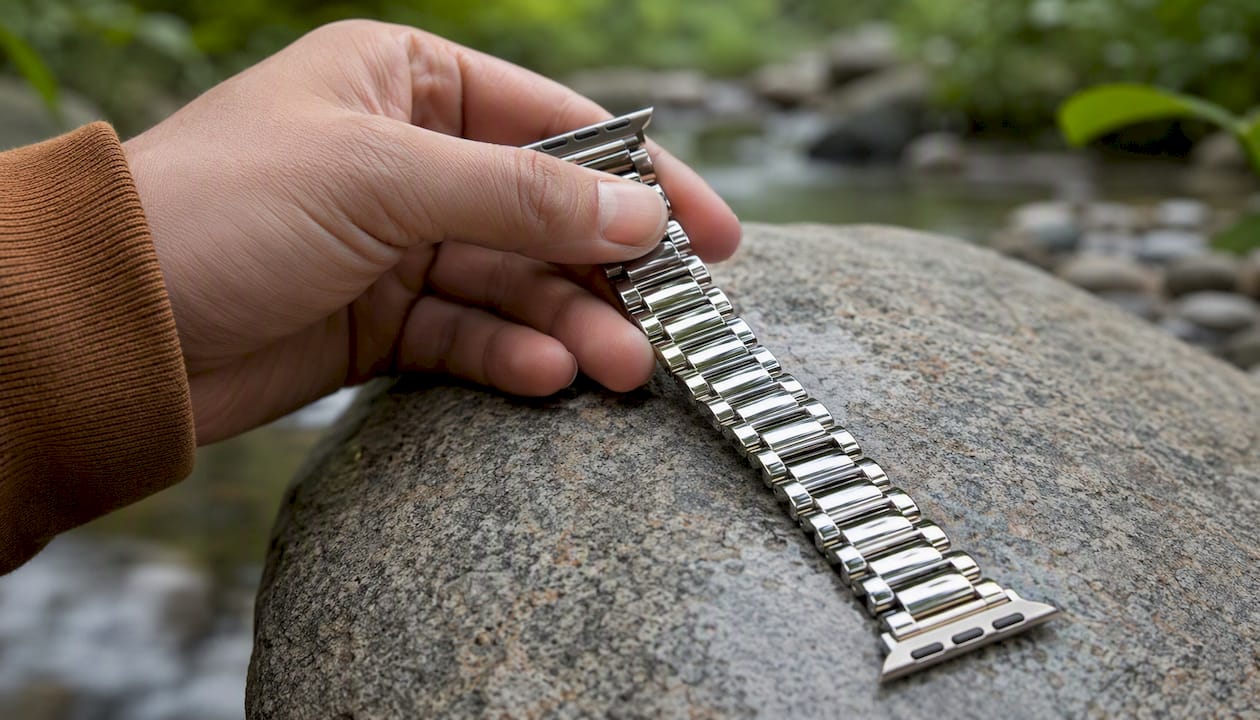
316L is the standard alloy for premium watch bands and jewelry for practical reasons. Its low carbon content and molybdenum content of roughly 2.25–3.0% improve corrosion resistance and reduce the risk of skin reactions, making it a reliable choice for everyday wear. The IMOA confirms that watchmakers use 316 and 316L steels specifically for their corrosion resistance and ability to handle the shocks of daily life.
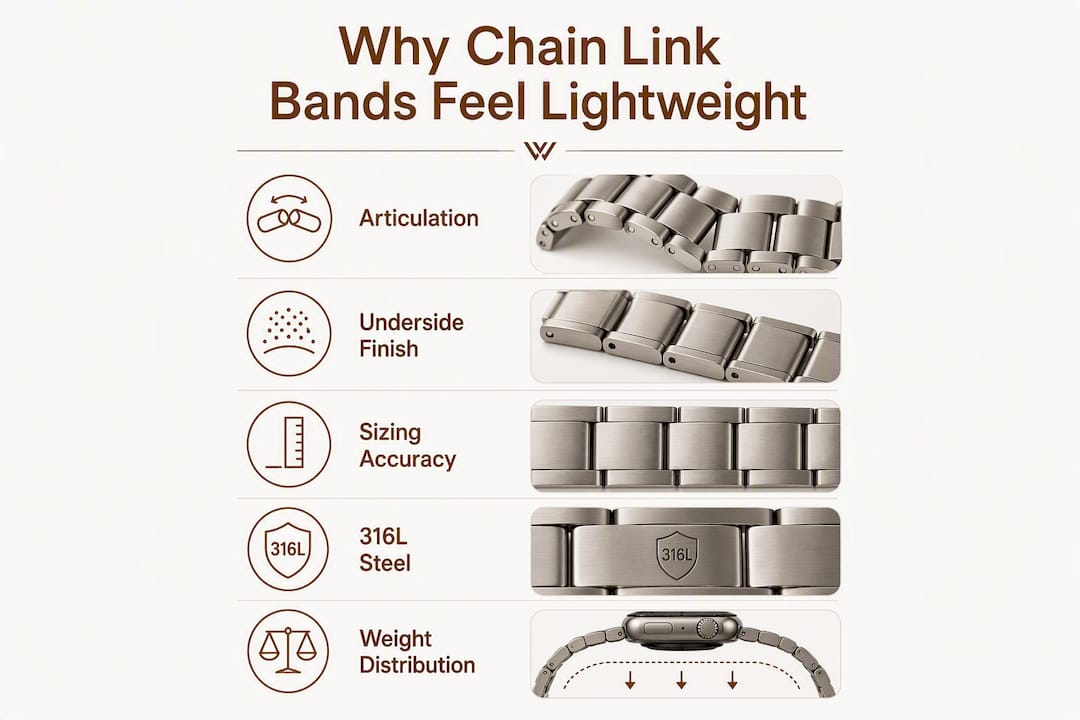
316L is denser than titanium, so it will never be the lightest metal option by raw mass. What it offers instead is stability of finish, long-term durability, and a satisfying heft that signals quality. 316L also delivers stronger scratch resistance than many comparable alloys, which matters for a band worn daily.
Key material properties worth knowing:
- Hypoallergenic: Low nickel migration and molybdenum content make it suitable for sensitive skin.
- Corrosion resistant: Handles sweat, water, and daily exposure without pitting or discoloration.
- PVD coating note: Rose Gold and Gold finishes rely on PVD coating over the base steel. High-wear points like clasp edges can show wear over time on lower-quality bands. Thicker PVD application and precise finishing extend the life of the color.
- Finish durability: The low carbon content in 316L also improves weldability, which means cleaner joins at link connections and fewer weak points in the band structure.
How correct sizing makes a band feel lighter immediately
Sizing changes perceived weight more than swapping metal types. A band that fits well distributes its mass evenly. One that is too tight creates constant pressure; one that is too loose shifts and flops, concentrating impact at the edges with every wrist movement.
- Measure your wrist at the point where you wear your watch, using a flexible tape measure or a strip of paper.
- Aim for a snug but not tight fit. You should be able to slide one finger under the band comfortably.
- Set the 12 o’clock side one link longer than the 6 o’clock side. This accommodates the wristbone and prevents the watch from sliding or creating a pressure point over the bone.
- Remove links in pairs (one from each side of the clasp) to keep the clasp centered on the underside of the wrist.
- Use the micro-adjust feature if your band has one. A single position of adjustment can be the difference between a band that shifts all day and one that stays put.
A correctly sized band settles into a natural resting position and stops moving independently of your wrist. That stillness is what makes it feel light. For practical guidance on all-day comfort, the fit rule above applies whether you are at a desk or on your feet.
When a “lightweight” feel is actually a warning sign
Some bands feel light because they are cheaply made, not because they are well-engineered. Hollow links, folded steel construction, and thin plating all reduce mass, but they also reduce durability and tactile quality. A band that rattles, flexes unevenly, or shows seam lines on the link faces is not a lightweight premium band. It is a low-quality one.
Refined craftsmanship — smooth, rounded edges and precise pin tolerances — is what separates a metal band that feels airy from one that merely feels lightweight because it is cheap.
Red flags to check before buying:
- Audible rattle: Loose pin tolerances produce a clicking or rattling sound when the band moves. Premium bands are near-silent.
- Hollow-sounding links: Tap a link with your fingernail. A solid, well-machined link produces a dull sound. A hollow one rings.
- Visible folded seams: Look at the link faces under light. Folded steel construction shows a seam line running along the edge. Solid links do not.
- Weak or wobbly clasp: The clasp should open and close with a firm, clean action. Any play or looseness signals a component that will fail under daily use.
- Uneven underside finish: Run your thumbnail along the underside. Any sharp ridge or rough edge will irritate skin over a full day.
Key Takeaways
Premium chain-link Apple Watch bands feel lightweight because precise articulation, rounded undersides, and correct sizing distribute mass evenly across the wrist, eliminating the pressure points that cause fatigue.
| Point | Details |
|---|---|
| Distribution, not mass | Perceived lightness comes from spreading weight across the wrist, not from reducing the band’s total mass. |
| Design details matter most | Rounded link undersides, butterfly clasps, and tight pin tolerances each reduce pressure points and rattle. |
| 316L steel: durable, not light | 316L stainless steel is denser than titanium but offers superior corrosion resistance, hypoallergenic properties, and finish durability. |
| Sizing changes everything | Setting the 12 o’clock side one link longer and removing links in pairs can transform how a band feels within minutes. |
| Wizeband’s approach | Wizeband builds 316L bands with rounded undersides, butterfly clasps, and quick-adjust systems designed for all-day comfort across Apple Watch Series 4–10, SE, and Ultra 2. |
The design choice that most people overlook
The conventional wisdom on metal watch bands focuses almost entirely on material: titanium versus steel, light versus heavy. That framing misses the point. The most comfortable metal band you can wear is not necessarily the lightest one by weight. It is the one engineered so that its weight disappears.
Hollow links and thin plating do reduce mass, but they also produce the rattle and flex that make a band feel cheap and unstable on the wrist. A well-made 316L band with tight tolerances, rounded undersides, and a butterfly clasp will feel more comfortable over eight hours than a lighter band with poor articulation, because comfort is a function of pressure distribution, not grams.
The detail most buyers skip is the underside finish. You can evaluate a band’s quality in thirty seconds by flipping it over and running your thumb across the link surfaces. Smooth and rounded means the engineering is there. Flat or ridged means it will dig in by midday. That single check tells you more about how a band will feel than any spec sheet.
Wizeband metal bands: jewelry aesthetics with all-day comfort
Style-conscious Apple Watch owners who want a band that looks like jewelry and wears like one deserve a band built to those standards. Wizeband designs premium 316L stainless steel bands with the exact features this article covers: rounded link undersides, butterfly clasps, articulated construction, and quick-adjust sizing systems that let you dial in fit without tools.
The Agatha Metal Strap and the Gaia Metal Strap are two examples from the lineup that combine multi-chain construction with a refined underside finish. Both are compatible with Apple Watch Series 4–10, SE, and Ultra 2, offered in Silver Gold, Starlight, Rose Gold, and Gold. If you want to try multiple styles, the WizeBand Starter Kit pairs complementary bands so you can compare how different constructions feel on your wrist before committing to one.
Recommended
From the blog
View all


Leave a comment